
In today’s fast-paced world, time often feels like it’s slipping through our fingers. Between digital distractions, packed calendars, and the pressure to always be “on,” it’s easy to feel overwhelmed. But time management isn’t about squeezing more into your day—it’s about organizing your time around what really matters. Whether you’re working from home, raising a family, or managing multiple side projects, these ten modern tips can help you take back control and move through your day with intention and focus.
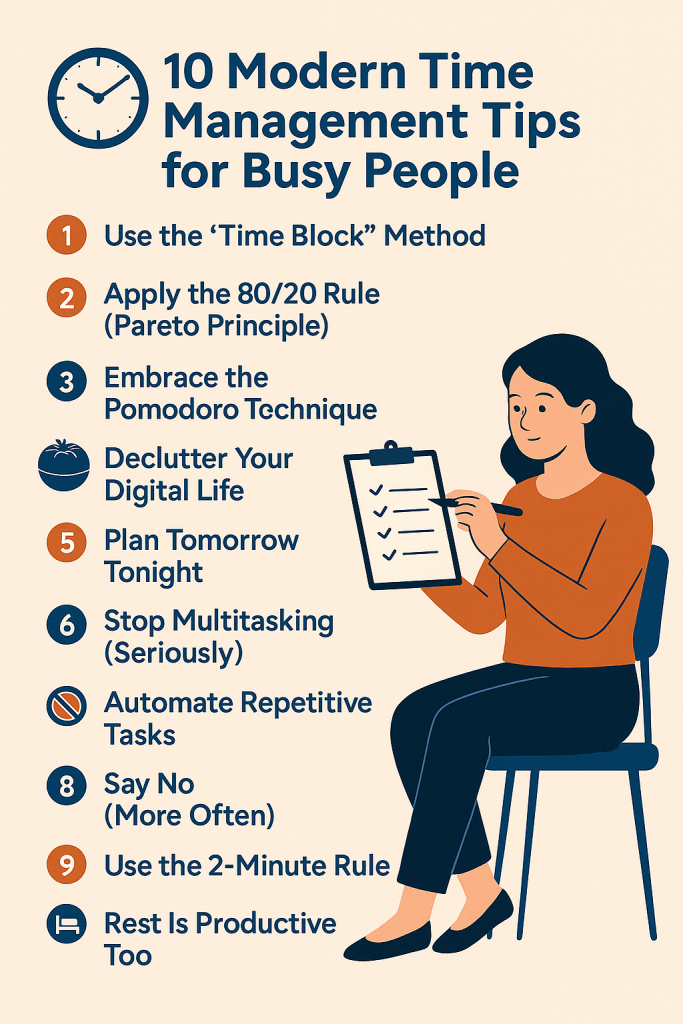
1. Use the “Time Block” Method
Time blocking is one of the most effective techniques for structuring your day. It involves dividing your day into chunks of time and assigning each block to a specific task or activity. Rather than multitasking or reacting to tasks as they come up, time blocking helps you stay proactive.
Example: Let’s say you’re a freelance writer. You might block 9:00–11:00 AM for writing, 11:00–11:30 AM for responding to emails, and 2:00–3:00 PM for client meetings. This structure reduces the mental load of constant decision-making and helps you stay immersed in one activity at a time.
Many professionals who implement time blocking find they get more done in fewer hours simply by reducing distractions and switching costs.
2. Apply the 80/20 Rule (Pareto Principle)
The Pareto Principle suggests that 80% of your results come from 20% of your efforts. In other words, not all tasks are created equal. The key is to identify the few high-impact tasks that move the needle and focus your energy there.
Example: If you run an online business, maybe only two out of ten marketing strategies actually drive most of your traffic. Or if you’re a student, perhaps reviewing key concepts from past exams gives you more benefit than reading every chapter.
Reflect regularly: What activities give you the most return on your time? Focus there and delegate, eliminate, or delay the rest.
3. Embrace the Pomodoro Technique
This method is simple but surprisingly effective. Work for 25 minutes, take a 5-minute break, and repeat. After four “Pomodoros,” take a longer break of 15–30 minutes. This builds in natural rest periods while still encouraging bursts of deep focus.
Example: A student studying for finals could use this technique to study biology for 25 minutes, rest, then move on to math. The rhythm makes studying feel less overwhelming and helps avoid burnout.
The Pomodoro method is especially helpful for people who struggle with procrastination. By making tasks feel smaller and more approachable, it lowers the barrier to getting started.
4. Declutter Your Digital Life
Clutter doesn’t just exist in your physical space—it lives in your inbox, desktop, browser tabs, and even your phone’s home screen. Digital clutter drains mental energy and creates friction every time you sit down to work.
Tips to declutter:
- Unsubscribe from emails you never open
- Close unused tabs and limit multitasking
- Delete or archive old files you no longer need
- Organize files into folders with clear names
Doing a quick 15-minute “digital clean-up” once a week can dramatically reduce stress and improve your productivity environment.
5. Plan Tomorrow Tonight
Planning the next day the night before takes just 5–10 minutes, but it’s one of the highest-leverage habits you can build. It allows you to start the day with clarity, rather than scrambling to figure out what to do.
Example: Before bed, jot down your top 3 priorities for the next day. When you wake up, you’ll already know where to direct your energy.
This habit reduces anxiety, improves sleep, and makes your mornings more intentional. It also gives you a chance to align each day with your bigger goals.
6. Stop Multitasking (Seriously)
Despite what popular culture may tell you, multitasking is a productivity killer. Studies show that task-switching can reduce efficiency by up to 40% and increase mistakes. The human brain works best when it focuses on one thing at a time.
Example: Trying to write a report while answering Slack messages and listening to a podcast may feel productive—but in reality, you’re slowing yourself down and increasing cognitive fatigue.
Instead, try task batching—group similar tasks together and do them in one focused session. For instance, check and respond to emails twice a day instead of constantly switching between tasks.
7. Automate Repetitive Tasks
If you’re doing the same task over and over, there’s a good chance you can automate it or streamline the process. Automation saves time, reduces human error, and frees up your brain for more important decisions.
Examples of automation:
- Setting recurring calendar reminders
- Creating email templates for common replies
- Using note-taking apps to auto-organize thoughts
- Syncing files automatically across devices
Even simple automations—like auto-paying bills—can make a big difference over time.
8. Say No (More Often)
Saying yes to everything is a recipe for burnout. To truly manage your time well, you must be willing to say no to tasks, requests, and opportunities that don’t align with your goals or values.
Example: If someone asks you to attend a meeting that doesn’t require your input, politely decline or suggest an email summary. If you’re asked to join a new project but you’re already at capacity, be honest about your bandwidth.
Time is a finite resource. Every “yes” is a “no” to something else—often your own priorities.
9. Use the 2-Minute Rule
From David Allen’s “Getting Things Done” system, the 2-minute rule is a game-changer: If something takes less than 2 minutes, do it now.
Example: Replying to a short message, filing a document, or wiping your desk—these micro-tasks are often delayed, but together they cause friction in your workflow.
Knocking out these quick wins not only keeps things tidy but also gives you a psychological boost of accomplishment.
10. Rest Is Productive Too
Rest isn’t a reward—it’s part of the process. Downtime helps you recharge, reset your mental focus, and return to tasks with renewed creativity and energy.
Example: After a full day of work, watching a show, going for a walk, or spending time with loved ones might feel “unproductive,” but these activities support your long-term well-being and focus.
Schedule rest like you schedule meetings. Protect your evenings, lunch breaks, and weekends when possible. Burnout costs more time than you save by overworking.
Final Thoughts
Time management isn’t about rigid rules or perfect schedules—it’s about learning how to manage your energy, attention, and priorities in a world that constantly pulls you in different directions. These ten strategies are starting points, not a checklist. Start with one or two, experiment, and see what works best for your lifestyle.
The goal isn’t to be perfectly productive—it’s to be purposeful with the time you have.
 TheFinanceNerd