Some jargon that you might find useful in preparing for the CAIA exam

The CAIA exam focuses on alternative investments and if you are new to the industry or to the subject, you might come across quite a lot of new terms. I have compiled a list of some terms that you might find useful in your studies.

2/20 (two and twenty): this refers to the fee structure that is charged by hedge funds. The 2 refers to the recurring 2% management fixed fee that is charged as a % of assets held. The 20 instead refers to the 20% fee that is charged on any investment returns.

Accredited Investor: accredited investors are individuals who are allowed to invest in sophisticated investments such as hedge funds, VCs, private placements, etc. In order to be classed as such, accredited investors need to meet a number of criteria such as having a net worth of $1,000,000 or having an income of at least $200,000 (these criteria might vary based on the country).

High-Watermark: this is the highest fund value reached by a fund. High-Watermarks are very important when we are talking about performance returns that are paid out to hedge fund managers. Let’s look at the below example:

Assuming a fund’s NAV (Net Asset Value) at inception in 2014 is 100 we can see that in 2015 it had a return of 20% and the NAV grew to 120. The fund will take 20% of the 20 that it made in profit (Year 2 NAV – Year 1 NAV which is equal to 120 – 100 = 20 from the table above). Therefore 120 is the High-Watermark at this stage.

Similarly, in the following year it rose again by 20 and now the returns are calculated in terms of any gains made above the High-Watermark of 120 so (140-120)*20%, the new High-Watermark now becomes 140.

In the following year we can see that the fund didn’t have such a great year and it’s NAV fell to 120. No performance fees will be paid as the NAV value was below the High-Watermark. If we look at the next year we can see that the fund posted some gains from 120 to 130 but still this is below the 140 High-Watermark so no performance fees arise.

CTA: stands for commodity trading advisor. This is a term used to define a hedge fund that aims to generate returns via futures, options and forex trading.

Vintage: vintage refers to the year when the VC fund was set up. When you are comparing returns of VC funds, it’s very important to compare two funds that have the same vintage. Fund performance will be hugely affected by the prevailing economic conditions from when the fund was set; comparing two funds with the same vintage allows us to make a fair comparison.

General Partners vs. Limited Partners: you will come across these terms when looking at private equity. The general partner will be involved in the day to day running of the VC firm where he or she will manage the projects and decide which projects to invest in. Limited partners on the other hand are not involved in running the VC firm but instead they provide the funds that the General Partners put to use to increase the value of the firm.

Cap Rate (Capitalization Rate): you will come across this term in real estate and you can interpret it as the yield that your property is offering. The Cap Rate is obtained by Net Operating Income (NOI)/Property Value.

REIT: stands for Real Estate Investment Trust. A REIT is a company that owns and operates a real estate portfolio. Real estate could range from warehouses, hospitals, commercial properties, residential properties and more. REITs are listed on exchanges and investors can buy REITs just like ordinary common stocks. REITs tend to have inflows of cash flows in terms of rent paid by tenants and this allows for such returns to be paid out to investors in the form of hefty dividends which could range from 2-6%. They could be a good for income generation and moderate inflation protection. REITs are sensitive to economic conditions and fluctuations in the property market.


I just sat my June 2019 CFA exam, what next?

This weekend saw a record number of 250,000 CFA candidates sitting the exam around the world. This is a whopping 11% increase compared to the previous year. If you are one of those candidates who just sat their CFA exam, I am sure a lot will be going through your head at the moment. After hours spent reading through study notes and solving questions, today was the big day and whilst you eagerly wait for your results I am sure that you cannot help but ask yourself one crucial question – have I passed?

Post exam I think candidates can be divided into three distinct categories. The first ones are those who think they absolutely nailed it. To these candidates if their confidence is legitimate and it was a genuinely good exam, I would like to congratulate them for their success without jinxing them. The ones in the second category are ones who just walked out of a dreadful exam and are fairly confident that they will be resitting in the following year and to these candidates my message is “don’t give up, learn from today’s mistakes and keep trying, perseverance will pay off in the future”. The last category which I was always part of and I think most candidates come under, are the ones who are somewhere in between the pass and fail mark. This post is mainly aimed at them.

At this stage, people in this category will be debating whether they should start revising for the next level (if they are level 1or 2 candidates) or keep studying for the exam that they just took. My advice for those people is to leave your books on the side and unplug yourself from the CFA exam for the next couple of months. For level 1 and level 2 you will get your exam results on 6th August, for level 3 instead you will have to wait until 20th August. If you really cannot resist the urge to study for the CFA exam, I recommend some light reading but don’t try to keep your pre-exam study schedule otherwise you will risk burning out before your next exam. When I was studying for the CFA exam myself, I kept getting told that exam preparation is like a marathon. I observed that candidates who revise at a steady pace and are able to maintain a healthy balance between their studies and a life outside their studies are the ones who are most likely to succeed. You should wait for your exam results to have all the required information to formulate your next study plan. If you did put in all the hours of preparation but cannot help thinking about how difficult today’s exam was, chances are other candidates found it hard as well. Remember the averaging passing score that CFAI sets is based on the difficulty of the exam; if you think you answered relatively well on a pretty tough exam I’d say that your chances of passing are good. If instead you dropped careless points on a relatively easy exam, chances are that other candidates will have done better, putting you below the average passing score.

Regardless of today’s outcome my final words of advice are to take a step back and to appreciate the journey rather than the result. Think of how much more knowledgable you are in the field of investment management and think of the people you met throughout your studies. Your future should not be defined by the outcome of this single exam, rather it will be defined by how you react when you are faced with tough challenges and occasional failures. Don’t give up and keep persevering in your journey.

CFA Level 3 General Overview and Tips

So you’ve reached the final CFA exam. This is not something to be sniffed at so you should be proud of your achievements. You are almost there and I am hoping that this article will help you in your studies and will guide you towards the right direction, so please keep reading.

IPS is King

If you have done some research on the exam format or you have attempted past questions, I am sure that you have noticed that for the first time you are not faced with multiple choice questions and instead you will have what they call ‘constructed responses’. Yes, you will have to write sentences using pencil and paper rather than marking an answer sheet. An IPS which stands for Individual Policy Statement is a type of constructed response question that you will see in the morning session, needless to say you need to be scoring high on IPSs if you want to pass. Please note that the afternoon format is multiple choice.

If I was explaining what an IPS is to my grandmother, I would tell her that it’s an assessment of her current finances and set of financial goals. You need to picture yourself as a financial advisor, helping your client come to grips with his or her financial situation; this entails being aware of any assets that are held, sources of income or any expenses. Given your client’s financial situation you need to assess the below points:

 Time horizon: what is your client’s time horizon? 10, 15 years? If we talk about inheritance this could extend to a longer period. Multi-generational time horizon is a buzz word you might want to take note of.  

·Taxes: should there be any aspect that would cause a high tax expense, note this down and remember to emphasise tax efficient investing.

·Liquidity: liquidity is very important. After having assessed your client’s outflows, is their source of income sufficient enough to cover them? If there are a lot of foreseeable expenses and your client’s wealth is concentrated in illiquid real estate then liquidity could be a problem.

·Legal: you don’t tend to see this come up but always acknowledge that local laws apply and should there be applicable laws from multiple jurisdictions, mention that.

·Unique: you will easily notice this. This tends to be some unique situation that your client is in. For example, the majority of their wealth might come from their company or it could be their aversion towards sin stocks.Then you will need to assess your client’s ability and willingness to take risk. Willingness is more related to cognitive aspects, so make sure to pay attention to any traits or biases that the person could exhibit. Ability is more of an objective assessment. Does your client have a sufficiently large portfolio and a long-term time horizon? Then chances are he/she will be able to afford having a more aggressive portfolio to aim for higher returns in the long run. If instead your client is retired and their portfolio is their only source of income and they have numerous upcoming expenses, then chances are high that you should be conservative. You should recommend your client to invest in safe instruments that provide a steady, reliable stream of income. 

OK so how do I nail an IPS question you might ask?

(1) Write concise and clear bullet points. When I was first tackling the questions I was making the mistake of writing long, convoluted sentences making it hard for the marker. The marker will have an answer key and will be ticking boxes to ensure that you covered the relevant points.

(2) Practise, practise, practise. You just need to get used to answering IPSs. A good thing about CFA Level 3 (unlike levels 1 and 2) you will have access to past morning exam papers, so make sure to attempt them and see what recommended responses the CFA Institute provides. When doing past papers though, be careful NOT to go too far back into the past as some of the questions will not be as relevant.

(3) If you have a study partner, try to mark each other’s papers. It might be helpful to have another person read your responses and give you some honest feedback as to whether you covered the main points. Sometimes when marking our own mocks we might give ourselves the benefit of the doubt whilst examiners might not.

(4) Passion. OK you might think that this might sound strange but try and think of yourself as a consultant or a financial advisor. Try and think of the people who pop-up in the question as if they were real clients, friends or family. After months or years of gruelling studies, you are the financial expert – what genuine advice would you give them so that they can reach their financial goals? I found approaching questions in this manner to be entertaining and helped concepts to stick in my mind.

Is CFA Level 2 harder than CFA Level 3?

This is a debate that I find very interesting. Some people pass level 2 and will tell you that you have cleared the hardest exam, others will tell you that level 3 is a real nightmare. I personally think that if you are the technical and mechanical type, you will find level 2 a fair exam. You should not approach level 3 with the same mind-set that you had for level 2, I certainly did and got punished for it. This might sound abstract but for level 3 you need to see the big picture. Level 3 isn’t about how quickly you can value swaps or calculate free cash flows, it’s about being able to understand your client’s situation and applying sound judgement in addition to technical knowledge. Level 3 takes for granted that you have understood the core concepts and requires you to put them into practise in the field of portfolio management. For this reason if you have started preparing for level 3, I would personally recommend just skimming through the whole curriculum and getting a general idea, then going into the nitty gritty details.

Calculators in the CFA Exam

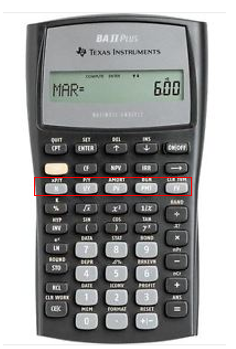
Although the CFA exam isn’t a number crunching exam, you will come across numerous questions that require the use of a calculator. Your two weapons of choice are the Texas Instrument BA II Plus and the Hewlett Packard 12C. Before buying your calculator, make sure to read the CFA Exam Calculator Policy that can be found here.

Also, if you are undecided between the two makes and you would like to try them, both brands have apps that you can go to your phone’s App Store and download. In terms of functionality the apps are identical to the physical calculators.

The main purpose of this article is to make you aware of the type of operations that you should know how to do via your calculator prior to attempting to sit the exam.

I will be using the BA II Plus for my explanations and examples (I will make a separate tutorial for Hewlett Packard lovers)

(1) Present Value/Future Value [Priority = High]

What is it?  Other than being able to quickly perform basic arithmetic operations on your calculator, I think this is probably one of the most important things you will need to be able to do. You will be given the amount of money in the bank account (PV), the prevailing interest rate and the period of time over which the interest will compound and from this you will need to compute the future value. You can be given any of the inputs and solve for the missing one.

If you have started with the basics and the concept of Time Value of Money is obscure to you, you might find this article helpful.

This is also applicable to fixed income where you have the market price of the bond, coupon payments and coupon payments frequency and you will need to compute the IRR of the bond. You can easily compute the present value of annuities or lease payments in Financial Reporting. Yes, simple Time Value of Money calculations are ubiquitous on the CFA exams so let’s get started.

Examples:

Q. A bond is trading at $102, it pays 5% coupon per annum and matures in 2 years. What is the bond’s yield?

A. Mathematically this is what you would see if you applied the formula for calculating the yield:

{ Bond Price } = \frac { C f _ { 1 } } { ( 1 + y ) ^ { 1 } } + \frac { C f _ { 2 } + \text { FaceValue } } { ( 1 + y ) ^ { 2 } }

If we look at the above formula for calculating the present value of a bond we can see that we are given everything except the y (for those who have studied corporate finance you can see that this is comparable to getting the IRR of a project), for the face value we can assume that it pays $100 at maturity.  This gives us the below formula:

102 = \frac { 5 } { ( 1 + y ) ^ { 1 } } + \frac { 5 + 100 } { ( 1 + y ) ^ { 2 } }

We will be using the grey buttons of our BA II Plus in the red box.

After ensuring that you have cleared the memory (2ND function + CE|C)

Please key in the following:

2 N button (you will see N = 2)

-102 PV (you will see PV = -102, make sure to put the negative sign here)

5 PMT (you will see PMT = 5, this was calculated as coupon rate * par or 5% * 100 = 5)

100 FV (you will see FV = 100)

Now that you have keyed in all the data, press the “CPT” key on the top left corner and press “I/Y”. If you keyed in everything correctly you will see that your yield is around 3.94%. If you press CPT and any of the inputs that you keyed in, you can verify what data has been entered. For example CPT PMT will still show you 5.

This was a very brief example but try playing around with the numbers, try changing the assumptions; for example you could easily verify that the price of the bond falls as you increase the Yield (I/Y) by gradually increasing the yield.

My example assumed that the coupon payment was 5% annual but if you were told instead that the coupon was 2.5% semi-annual, remember to also multiple the N * 2. At first, if you are not sure draw a diagram of all the future cash flows.

(2) NPV/IRR [Priority = Medium]

What is it?  Although there is an overlap with the previous topic, I thought this part deserved its own section. With regards to overlap I mean that we are still asking the calculator to compute present values, summing them or solving for IRRs. For some examples you can use the PMT button as shown above to get an answer to NPV and IRR questions. However, the limitation is that PMT only takes the same cash flows, i.e. if you are looking for the present value of something that pays $100 over 10 years at a fixed rate, let’s say 5% cost of capital, then you can just key in 10 N with 5 I/Y followed by 100 PMT and 0 FV then pressing CPT PV to get your answer of -$772.17.  What about a question to calculate the present value of a project that requires an investment of -$1000 at initiation or year 0, then pays $500 in year 1, $300 in year 2 and $400 in year 3. Your cost of capital is 3%.  This is where you cannot use PMT and you need to key in the cash flows for discounting.

Examples: I will use the example that I just introduced. Again this is a simplified example to illustrate the steps and you should definitely expect harder questions.

The below formula will yield the NPV for this project:

NPV = - \text {Initial Investment} + \frac { C F _ { 1 } } { ( 1 + r ) ^ { 1 } } + \frac { C F _ { 2 } } { ( 1 + r ) ^ { 2 } } + \frac { C F _ { 3 } } { ( 1 + r ) ^ { 3 } }

Plugging in the numbers we get:

1,000 + \frac { 500 } { ( 1 + 0.05 ) ^ { 1 } } + \frac { 300 } { ( 1 + 0.05 ) ^ { 2 } } + \frac { 400 } { ( 1 + 0.05 ) ^ { 3 } } \cong 93.83

Now let’s obtain this number on the calculator.

Please key in the following:

CF (this button just next to the yellow 2nd key), you should see CF(0) = 0, now just to be sure that we don’t have any data from previous exercises, please clear the memory by pressing 2ND function + CE|C. Once you have done this you can press the up and down arrow keys that are found on the top right next to the ON/OFF button to see what data is stored. You should see CF(0) = 0, C01 = 0, F01 =0. We are ready to start:

CF(0) = -1000 ENTER, you will see CF(0) = -1000. Press the down arrow to key in the next cash flow.

C01 = 500 ENTER you will see C01 = 500. If you press the down arrow key you will see F01 = 1. This indicates the frequency of the cash flows. For example if you want the same cash flow of 500 being paid 3 times from years 1 to 3 then you can enter 3. In our case we have only one payment so we will keep the default value of 1 and press the down arrow again.

Now you will see C02 and you will be able to enter the second cash flow of 300. Repeat this for the final cash flow of 400 and once you have entered all the cash flow data we can compute the NPV.

You should see C03 = 400 on your calculator. Now press the NPV button and you will see I = 0 on your calculator. Key in 5 and then press ENTER (important to note that 5 will be 5% so do not enter 0.05 otherwise you will enter 0.05%) now press the down arrow and you will see NPV = 0. Press the CPT key on the top left and you will see the NPV result of 93.83 and we are done. If you want to amend your rate you can press the up arrow which will display the “I”, enter a new rate and again press the down arrow and press CPT to calculate the NPV on the new updated rate.

(3) Storing Results [Priority = High]

What is it?  You can use the STO and RCL keys to store calculation results and quickly recall them for future use. Before I was aware of this feature I used to write down any interim calculation results on paper, then I used to key in those results in my calculator to perform calculations. This had some drawbacks as it was time consuming and prone to careless errors, not to mention the loss of accuracy due to rounding.

Example: for example let’s say 105.723 is your answer and you want to store this value for future use, press STO and then any number on your number key that you want to use to store this value. Let’s say I want the number “7” to store this value press the key order STO 7. Now try entering any number or clearing your work with CE|C. Now you can recall the previous number that we stored in memory by pressing RCL and “7”, magically 105.723 will appear on your calculator.