Career Development: Levelling up with the right qualification and experience

An important piece of advice that I received when I started working as a new graduate was about how I needed to continue investing in my personal development if I wanted to be successful in my career. One manager at my first firm went as far as telling me that he spent 10-20% of his income every year in his personal development during his early career. In my case, I didn’t have a fixed monetary amount but every year I made a conscious effort to have some additional personal development goal outside of work. Very often this was in the form of attaining a professional qualification. Before you continue reading, I want to make my view clear, I’m not professing that going out there and collecting degrees and letters after your name is the winning tactic. Ultimately, your success at work will depend on how well you can do the job and communicate your contributions to key stakeholders. What I am saying is that especially in a very rapidly evolving job market like the one we are seeing today, failing to grow your skillsets might not just stop you from getting that promotion but might even be detrimental for your career and job stability as a wide range of jobs become obsolete due to the development of new technologies.

Continue reading

Re: Bloomberg Opinion Piece: “Wall Street’s CFA Program Is a Colossal Waste of Time”

On 17th August 2021, Bloomberg published an opinion piece titled “Wall Street’s CFA Program Is a Colossal Waste of Time ” and this post is a response to that article. The CFA Charter has very often been regarded as the gold standard when it comes to qualifications in the financial industry and this article has undoubtedly ignited some discussions, with subreddit threads such as this one being just one of the few examples. Calling the CFA program a “Colossal Waste of Time” seems to be a pretty bold statement and given that in the article the author (Jared Dillian) mentions that he passed level I but never completed the qualification, a lot of readers were quick to dismiss his opinion. The author also expressed his view that he favours MBAs over the CFA program which caused a slight digression towards the comparison of the two qualifications. However, some readers were eager to identify elements of truth in the article as they possibly mull over their options following the decrease in pass rates for the latest sittings.

Continue reading

May 2021 CFA Level I Results at Historical Low, only 25% Pass

The May 2021 numbers for the level I exams have recently been made public, a result that saw only a quarter of test takers get a pass. This is an extremely low pass rate and to put this number into context, this is the lowest pass rate in the exam’s 58-year history. By looking at the historical pass rates published by CFAI, we can see that the percentage of candidates passing the exam is between 40-50%.

woman biting pencil while sitting on chair in front of computer during daytime
Continue reading

OK, I got the CFA charter, what now?

As someone who got the CFA charter six years ago, I recall that when I was studying the curriculum, I came across a lot of advice on forums where discussions were centred around passing the exams but after passing my level III exam, I felt that I needed more guidance on reaping the rewards of my hard work. If you passed the level III exam, chances are that you studied over 1000 hours (this is a rough calculation based on the study hours that CFA Institute estimate). Having had six years of experience as a professional with this designation and having changed jobs a number of times, I would like to share some thoughts that I am hoping newly qualified charterholders might find helpful.

Continue reading

Japan Investment Conference 2019: The Multi-Stage Life and The Challenges Facing Financial Services

This is an event that I attended a couple of weeks ago and the agenda can be found here:

Click to access JIC2019_agenda_EN.pdf

This was a special event as it was also an opportunity to commemorate CFA Japan’s 20 year anniversary. The topic which was chosen was also interestingly titled “The Multi-Stage Life and The Challenges Facing Financial Services”; this deviated from past topics that the society had chosen and there were a lot of people expressing their opinions that this was more aimed at individuals and wealth advisors rather than your traditional institutional investors. Nevertheless I thought the event was a success.

Out of the speakers, Dr. Andrew Scott from the London Business School was one of the main speakers and his presentation was based on his book “The 100-Year Life – Living and Working in an Age of Longevity”. Other presentations followed this theme regarding our longer life expectancies across countries and the need to prepare for a multi-stage retirement phase.

The ongoing debate regarding this trend up until now has been to consider working and retirement as a two stage process. You pretty much work all your life, put money on the side in terms of savings, state pensions and or private pensions. You reach 60 or 65 or whatever the retirement age is in your country and you tap into your pension pot and your assets during your retirement. Assuming a life expectancy of 85-90 that’s 20-25 years that your retirement pot needs to last. If you are looking at 30 years +, it simply isn’t feasible to to have such a large retirement pot. Governments need to get to grips with this reality. Financial service providers will undoubtably capitalise on this and more importantly, as individuals we need to be aware of this and plan accordingly.

Wealth as a Portfolio of Intangible Assets

This was a very important point that was brought up and changed the way I perceive the accumulation of wealth towards retirement. Up until now, I was only looking at retirement in terms of the cash inflows that you could get from your retirement pot (regardless of whether this is in the form of annuities or income from your portfolio). This could not be further from the truth; firstly, our health is a key asset that needs to be treasured, especially in retirement. A healthier life will also result in a reduction of medical bills. Another point worth noting is the earning ability which shouldn’t automatically go to 0 as we retire. As individuals are likely to lead a multi-stage retirement phase, we might see people in their 60s transitioning in other type of roles. For companies, it’s important to treasure this generation who will be abundant in the workforce. As individuals we need to keep aware of our earning abilities and ensure that our skillsets are still required in the current labour markets.

My Thoughts

Financial Institutions will inevitably need to perform a paradigm shift as we see this demographic change. From an asset allocation perspective, I am interested in seeing how individual portfolios will change to have slightly more aggressive allocations to meet long-term return requirements whilst addressing possible liquidity needs especially in retirement years. This is an area that I am very keen on and that I will be researching in the upcoming months. The solution might be that the level of risk might not be optimal for the individual. In such cases, we should look at longer working years to boost portfolio contributions. Overall I think the start is educating people and spreading awareness of this trend; we all need to be conscious that this is a change that we will see in our generation.

CFA Results Are Coming Out on 6th August 2019.

So, if you took the June exam, tomorrow is the day that you have been waiting for. Level 1 and Level 2 candidates across the the world will be receiving their CFA scores. Level 3 candidates will have to wait a bit longer. After 9:00 AM E.T. you will get an email from the CFA institute titled “Your CFA Exam Results” . The contents of the email will look like this:

From the first line you can tell straight away if you failed and the email should start with “We regret to inform you….”.

Myths regarding the timing when you receive your email.

The CFA institute says that you will receive your email after 9:00 AM E.T. and some candidates can expect to wait hours before they receive the email. When I was waiting for my exam results, constantly refreshing my inbox and reading forums, people were speculating that candidates who received their emails first had passed and candidates who received their emails later had failed. Over the years I have reached the conclusion that this is utter nonsense and that the order is irrelevant. I have come across both passing and failing candidates who received emails relatively early.

How to interpret the scores?

Unfortunately you will not get told the questions that you got wrong so you will have to look at how strongly you scored in the three bands (<=50%, 51%-70% >70%). Needless to say, if you have many <=50% chances are that you failed. However as I am sure that you are aware, not all topics are weighted equally so if you scored well in highly weighted topics such as equity and financial reporting that might have been enough to offset poor results in other areas. If you failed marginally, the important thing to do now is to identify your weaknesses and to focus on those areas when re-taking the exam, whilst retaining what you learned for other topics.

If you have failed on most topics, don’t despair. In that case, in addition to spending more time in preparing, I strongly advise you to review your study techniques. Exam taking strategies play a key role in the CFA exams so speak with friends who passed and see what worked for them.

I disagree with the marking.

Yes, if you failed marginally and you are confident that you should have passed, you can ask the institute to remark the exam. This will set you back $100 and chances are that things won’t work in your favour, although I have come across a few online posts where candidates were boasting of having had a fail result changed to a pass after asking for their papers to be remarked.

Preparing for the next level.

If you are thrilled that you passed and you want to leverage this positive momentum to get started in your preparation for your next exam, I recommend that you read the following articles where I provide some study tips for levels 1, 2 and 3. I will never get tired of saying this, although all levels share common themes and topics, the type of questions and skill sets required to succeed in each level differ a lot.

I would like to conclude this post by congratulating all candidates regardless of their results. These are not easy exams and only the people who have undergone the preparation and took the exam can understand the effort that it takes in passing. Having had the charter for roughly 3 years now, I am confident that you will reap the rewards of your hard work, so good luck with your journey.

I just sat my June 2019 CFA exam, what next?

This weekend saw a record number of 250,000 CFA candidates sitting the exam around the world. This is a whopping 11% increase compared to the previous year. If you are one of those candidates who just sat their CFA exam, I am sure a lot will be going through your head at the moment. After hours spent reading through study notes and solving questions, today was the big day and whilst you eagerly wait for your results I am sure that you cannot help but ask yourself one crucial question – have I passed?

Post exam I think candidates can be divided into three distinct categories. The first ones are those who think they absolutely nailed it. To these candidates if their confidence is legitimate and it was a genuinely good exam, I would like to congratulate them for their success without jinxing them. The ones in the second category are ones who just walked out of a dreadful exam and are fairly confident that they will be resitting in the following year and to these candidates my message is “don’t give up, learn from today’s mistakes and keep trying, perseverance will pay off in the future”. The last category which I was always part of and I think most candidates come under, are the ones who are somewhere in between the pass and fail mark. This post is mainly aimed at them.

At this stage, people in this category will be debating whether they should start revising for the next level (if they are level 1or 2 candidates) or keep studying for the exam that they just took. My advice for those people is to leave your books on the side and unplug yourself from the CFA exam for the next couple of months. For level 1 and level 2 you will get your exam results on 6th August, for level 3 instead you will have to wait until 20th August. If you really cannot resist the urge to study for the CFA exam, I recommend some light reading but don’t try to keep your pre-exam study schedule otherwise you will risk burning out before your next exam. When I was studying for the CFA exam myself, I kept getting told that exam preparation is like a marathon. I observed that candidates who revise at a steady pace and are able to maintain a healthy balance between their studies and a life outside their studies are the ones who are most likely to succeed. You should wait for your exam results to have all the required information to formulate your next study plan. If you did put in all the hours of preparation but cannot help thinking about how difficult today’s exam was, chances are other candidates found it hard as well. Remember the averaging passing score that CFAI sets is based on the difficulty of the exam; if you think you answered relatively well on a pretty tough exam I’d say that your chances of passing are good. If instead you dropped careless points on a relatively easy exam, chances are that other candidates will have done better, putting you below the average passing score.

Regardless of today’s outcome my final words of advice are to take a step back and to appreciate the journey rather than the result. Think of how much more knowledgable you are in the field of investment management and think of the people you met throughout your studies. Your future should not be defined by the outcome of this single exam, rather it will be defined by how you react when you are faced with tough challenges and occasional failures. Don’t give up and keep persevering in your journey.

CFA Level 2 General Overview and Tips

If you are reading this post, chances are you’ve passed the Level 1 exam. If that’s the case, congratulations, that’s a great achievement! Give yourself a pat on the back before you start worrying about how to tackle level 2.

In the Level 2 exam you are tested in the form of 20 case studies or item sets (10 in the morning and 10 in the afternoon). Each item set has 6 questions so that’s a total of 120 questions in 6 hours. The topic weights can be found here.

Compared to the level 1 exam, level 2 goes into much more detail in terms of testing concepts. If the theme of the questions in level 1 were “Do you know it?” level 2 instead asks “Can you apply it?”. A lot of candidates end up failing this exam as they find the number of formulas overwhelming and intimidating. In this post I have summarised some advice that I received when preparing for the exam, advice that I hope helps you pass the exam.

(1) Don’t try to memorise the formulas but try to see the big picture.

I’ve seen so many candidates trying to just blindly memorise and apply formulas, losing sight of the big picture. This is dangerous in my opinion. If you are the type who does well in memorising and applying formulas, then I’m not here to dispute your exam technique. If you have tried doing a few mocks and have been constantly scoring +60% then by all means please stick to your way. What I am trying to say is that from my experience, I struggled when I attempted to memorise all the formulas and when I applied a more intuitive approach in solving questions that worked for me. This might sound a bit abstract so let me give you an example.

Let’s say you are looking at Economics where you might be asked to adjust the exchange rate using PPP (Purchasing Power Parity). In our example we will use Japan and the US, the exchange rate is USD/JPY = 110 JPY and the inflation rate in the respective countries is 1% and 2%. The essence of PPP is that whether you buy goods in Japan or the US it shouldn’t make a difference.  If goods are becoming more expensive in the US compared to Japan, i.e. higher inflation, this will be reflected in the expected exchange rate where Japan is the domestic currency and the inflation is for a 1 year horizon.

E ( S ) = S _ { 0 } \times \frac { \left( 1 + i _ { f } \right) ^ { n } } { \left( 1 + i _ { d } \right) ^ { n } } = 110 \times \frac { ( 1 + 0.01 ) ^ { 1 } } { ( 1 + 0.02 ) ^ { 1 } } \cong 108.92

OK, you might ask what’s so hard about applying such a seemingly innocent formula. To start with, I have seen a lot of candidates spending a lot of time in trying to figure out how the exchange rate is quoted, which currency is domestic and which one is foreign (others used quoted and base); add the pressure under exam conditions and you are prone to make mistakes. The way I used to approach this question was to tell myself: OK, inflation rates are higher in the US and that means that their currency will have to weaken against the Yen. I would apply the formula and check my result. I can see that indeed 108.92 < 110. At first 1 USD could get you 110 JPY, now it can get you only 108.92 JPY. Indeed the Yen has strengthened (or the Dollar has weakened). Should I have accidentally flipped the numerator and the denominator, this check would have allowed me to detect my mistake. This was just a simple example but this way of thinking can be applied to many other questions on the CFA exam. There are a lot of red herrings on the exams so being able to spot and avoid them is a key factor in your exam success.

(2) Tips for Level 1 are still valid.

What I covered in my CFA level 1 post is also applicable to Level 2. Pay attention to the exam weightings in your preparation to ensure that you are scoring well in heavy topics like accounting and equity. Decide whether you want to pay a training provider or whether you have the time and discipline to self-study; this is definitely something you want to consider if your job is taking up a lot of revision time. The competition in Level 2 is fierce and chances are slim that you will pass with just 1-2 months of cramming.  This is an exam where candidates who put in 200+ hours of studying end up failing.   

(3) Don’t read the whole item set before attempting the questions

When I first started tackling exam questions I used to read the whole case study before moving on to the questions. My mind was bombarded with information and the questions were very detailed so I found myself going back to the item set and looking for key piece of information, then going back to the questions, going back and forth. Needless to say, I was struggling with time. It was only throughout my revision that I realised the obvious; item sets are very often divided into paragraphs and there tends to be a one to one map between paragraphs and corresponding questions. Just to be clear, if there are 3 paragraphs and 3 questions, paragraph 1 will have the information that you need for question 1, paragraph 2 will have the information for question 2 and so on. My advice is to first read the questions and then start reading the item set; when you are reading the item set, if you think you have identified some information that will help you solve any of the questions, then solve the questions before moving on. This approach also helped me from a mental perspective as when I was done reading the item set I wouldn’t be going back to 6 blank questions.

(4) Find a topic where you can differentiate yourself from other candidates

In order to pass the CFA exam you will need to achieve what they call a minimum passing score; the CFA institute uses the Angoff Standard Setting Method in determining this. If you are getting the bulk of your points from easy questions, chances are that other people sitting the exam will be getting those as well. If overall the exam was an easy exam the pass rate will be set higher and therefore even if you do average or just slightly below average, chances are that you will fail the exam. You obviously need to get points in the easy questions but you also need to score in questions where other candidates struggle to get an edge over them. In my case, for level 2, derivatives was the area that helped me. A lot of candidates around me had given up hope on derivatives as they found a lot of the questions challenging. I persevered and I was rewarded on exam day.  

I hope you found this advice useful and don’t forget to leave your comments. Good luck with your preparation and with your CFA journey!

The Time Value of Money

The Time Value of Money is a core concept in finance. If you are in the early stages of your studies in the field of finance then this is a concept that you want to ensure that you understand well. In your Finance 101 class your professor might have asked you, “Would you prefer $1.00 today or would you prefer a dollar tomorrow?”. This is when students shout out “A $1.00 today is more valuable assuming no negative rates”.

They would be absolutely correct as a dollar today could be immediately deposited in a bank account to earn interest. Just to avoid adding unnecessary complications we are assuming that any payments in the future are guaranteed so there is no element of uncertainty in the expected payment; both payments are guaranteed so the only differentiator here between a dollar today and a dollar tomorrow is the opportunity cost of losing out in interest payments. So, when you are presented with this question, remember to think of what you could be doing with the money in hand. Interest earned from a bank account was just an example but what if you have a valuable project that you could invest in today to double your cash?

The Relationship Between Future Value and Present Value

So how about $0.97 today or a $1.00 in a year, which would you prefer? Now the answer to this question isn’t as obvious. We first need to make a very important remark as $0.97 and $1.00 are not two quantities that we can compare. We need to compare apples to apples. We can do this in two ways: (1) find what $0.97 would be in terms of Future Value or (2) We can find out how much $1.00 is expressed in Present Value terms. The second method is more common, especially if we think of projects which require immediate cash outlays. I call the option of getting $0.97 today Option A and the option of getting $1.00 in a year Option B.

Assuming you get 3% interest rate for depositing your cash in a bank account, you can calculate how much you would end up with in a year’s time.

FV = Deposit + Interest or 0.97 + (0.97 * 0.03) = 0.9991

A more generic way of calculating future value is:

FV = (1+r)^n * PV

where, r is the interest rate and n is the compounding frequency, in this case 1 year so n = 1. Via the above formula you can calculate the Present Value of your $1 in a year’s time.

FV = PV/(1+r)^n

therefore, 1.00/(1+0.03)^1 = 0.97087

Now we can compare like for like, for Present Value we can summarise our findings in the below table:

Present ValueFuture Value
Option A0.970.9991
Option B0.970871

We can see that both in Present Value Terms and Future Value Terms Option B, or getting $1.00 in a year, results in us being better off.

Time Value of Money is a very powerful concept that comes up everywhere in finance. Whether it is in the form of evaluating companies and projects or finding the fair value of a complex derivative trade, we must always take into account the Time Value of Money in our models.

What Is Duration and Why Does it Matter?

Throughout your studies of fixed income, very often you will have come across the concept of Duration. So why is it so important? Duration measures the sensitivity of your bond to changes in interest rate. Let’s say interest rates drop 1%, by using duration you can get a rough approximation of how much your bond price changes.

Bond Price and Interest Rates

Before we get started with Duration, let’s talk about bond prices and interest rates. You might have heard the expression that bond prices and interest rates are negatively related. Interest rates go down and your bond price rises, interest rates rise and your bond price drops. This is because the value of your bond is the summation of the present value of all future cash flows, so the higher your discount rate (interest rate) the lower the price of your bond.

Let’s assume that we have a bond that pays a 5% yearly coupon with a face value of 100, prevailing yields are 6% across all tenures. For simplicity, I am assuming that we have a flat yield curve with interest rates constant across all tenures.

Assumptions
Coupon 0.05
Face Value 100
Yield 0.06
  Years CFs CFs PV
Year 1 1 5 4.7170
Year 2 2 5 4.4500
Year 3 3 5 4.1981
Year 4 4 5 3.9605
Year 5 5 105 78.4621
Bond Price 95.78764

As the the coupon rate of 5% is lower than the prevailing 6% rates, the bond is trading under par. Given the above assumptions we will calculate two key duration measures, the Macaulay Duration and the Modified Duration.

The formula for Macaulay Duration is as follows:

 D_{mac} = \frac { \sum _ { i = 1 } ^ { N } \frac { t C _ { ( i ) } } { \left( 1 + r _ { i } \right) ^ { t } } } { P _ { 0 } } = \sum _ { t = 1 } ^ { N } t W _ { ( t ) }

Where  P _ { 0 } is the price of the bond,  r _ { i } is the yield to maturity and t is the year. Applying the formula in our example we get that the Macaulay Duration is 4.53 years. We can interpret this figure as the average number of years that it would take for the bond to repay the initial investment.
The formula for the Modified Duration is as follows:


 D_{mod} = \frac { D_{mac} } { \left( 1 + \frac { \mathrm { r_{i} } } { \mathrm { n } } \right) }

Applying the formula we obtain 4.32 for the Modified Duration.

Now that we have the Modified Duration for this bond we can evaluate its sensitivity to changes in interest rates. The expected change in the bond price can be approximated by Modified Duration * Change in Rate * Bond Price. Looking at our example, if we assume that interest rates drop from 6% to 4%, then -4.32 * -0.02 * 95.79 = 8.27 is our estimated change in bond price and in reality we saw that the bond did rise by 8.66 so we can see that our approximation was quite accurate.

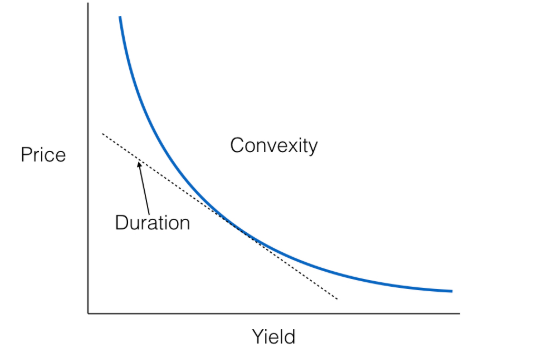
Duration however is only accurate for small changes in interest rates as it is only a linear approximation; we can see from the below graph that the relationship between interest rates and price is convex.

If Duration is the first order derivative between price and interest rates, we can better approximate the actual change in price by adding a second order term in the form of Convexity. I will be covering this in future posts in addition to other Duration measures such as Key Rate Duration and Effective Duration.