
Trading FX

I have been trading FX for 3 years now and as I am starting to become profitable in my trades, I would like to share with you some of my findings to help newer traders avoid some of the common mistakes that I made. I strongly believe that people following the below points should be able to move away from the 90% of losing traders and join the 10% of profitable (or breakeven) traders.
By all means, this is not a post that will transform you into advanced traders overnight, but it summarises a lot of sound advice that I came across during my journey as a retail trader.

Find the right broker
Having tried many platforms, I soon realised the importance of working with an interface where you are comfortable making trades. You will be spending a lot of time staring at charts, so you want to ensure that the platform is pleasant to use and well-equipped with all the tools that you need. I believe that the below criteria should be satisfied:

  • Good charting, ability to customise and plot all the technical indicators that you need
  • Speed of execution (I realised the importance of having an execution system where you can swiftly adjust stop losses, take profit levels as price moves)
  • Notification/Alerts: I have learned the importance of using alerts that notify you when certain technical indicators are breached so that you don’t have to stay glued in front of the screen the whole time

In selecting a broker, you also want to ensure that you check what spreads your broker is charging. The higher the spreads, the more this will erode your returns. Brokers that are accessible to you will depend on the region where you are based but for Japan at least there are numerous comparison websites for a) spreads b) swap points, between different providers.
The spread refers to the bid-ask spread that your broker is quoting you. The higher the spread, the higher disadvantage you will have when entering and exiting trades. The swap rate instead is the interest rate differential between the two currencies; for example, if you are selling JPY which has low interest rates and buying USD which has higher rates, you will have a positive carry and swap points will be added to our account on a daily basis.

Identify what kind of trader you are
There are different type of trading styles and such styles are mainly based on the frequency of trading and holding time period. Traders can be classified as Scalpers, Day-Traders, Swing Traders, Position Traders. Whilst scalpers might enter into numerous trades throughout the day in the attempt of making few pips in each trade, Position Traders who are on the other side of the spectrum, will hold onto positions for months as they seek a longer-term price movement in their favour. It is important to understand where you fit as a trader as this will dictate your position sizes, stop losses and take profit levels.

Stick to a few currency pairs
They say that each currency pair is unique and has its own characteristics and I couldn’t agree more with this claim. In my case, I have been focusing on GBPJPY (one of the most volatile pairs as this pair is very sensitive to global risk appetite). As I have been gaining more and more experience in trading this pair, I have been getting a feel for how it tends to move, how news announcements affect it, and at what price ranges it trades. You must develop that gut feeling for the FX pair that you are trading and this is difficult to do if you spread yourself thinly on several pairs.

Treat your losses as educational fees
Losses are an inevitable part of the game; you are betting on an uncertain outcome so there is always a possibility that price might move against you and you will have to realise a loss. When you are in a losing position if you have set up a disciplined and rules-based trading system, you should have a stop loss and your trade should have already been closed. If you haven’t set a stop loss (which his not advisable) and you are in a position where you need to make a decision. I have been in this situation multiple times, especially in my first months of trading. I kept thinking that the price would eventually move back in my favour and let the trade play out. I can guarantee to you that this is how you will accumulate massive losses so as hard as it might be to depart from your hard-earned cash, learn to cut your losses short and prepare to fight future battles. A good way to help you cut your losses is to treat them as fees that you pay to learn, it is very important that you analyse the outcome of that trade to avoid future mistakes.

Setup stop losses and think in terms of Risk & Reward Ratio
I already briefly mentioned this in previous paragraphs, but this is so important that it deserves its own section. Stop losses are there to protect your whole capital when the price moves against you. It’s fine to lose trades here and there, what will keep you in the game is to be making money on average after considering a large number of trades. This idea of expected trade winnings is very important and links perfectly with the concept of Risk & Reward Ratio. In very simple terms, you are telling yourself, how much money you are willing to risk to make a certain amount. Let’s say, you are looking to enter a trade that can make you 30 pips and you set up a stop loss of 10 pips, then your Risk & Reward Ratio is 30/10 or 3. You need to start thinking of trades in terms of expectations rather than looking at individual winners or losers. Before I enter a trade, I always ask myself if the trade has a positive expectation. If it does, this helps me realise my losses quickly so that I can enter into new trades that will more than offset the losses and make me profitable in the long run.

Keep your strategy simple
When I initially started trading FX, I thought that profitable traders had sophisticated charts, arcane entry signals and complex algorithms. As I started researching profitable strategies and following successful traders, I quickly realised that this belief couldn’t be further away from the truth. A lot of the strategies are very simple and require discipline and patience in the execution but are proven to be very effective. Strategies are important but they must be adapted to people’s unique trading styles and must be coupled with rigorous risk management.

FX is a mental game
When I tell people that I trade Forex very often I am told that it’s very risky. FX is risky only if you trade with no clear strategy, let your mental emotions take over and overleverage. If you approach FX in a disciplined and methodical way it has the potential for being very profitable. My advice to take control of the mental game is to start trading small amounts and learn more about yourself. Play money won’t be a good indicator so be sure to start with very small amounts that you can afford losing. As you start testing your strategies and start becoming profitable, start increasing your position sizes to a level where you feel comfortable. If you over-leverage, you will end up making decisions that are driven by emotions rather than sound rational rules.

Keeping Track of your P&L and entry/exit decisions
I would like to conclude with the most important piece of advice. I strongly advise that you keep a diary and document your trading decisions in addition to keeping a spreadsheet where you calculate your P&L. This will help you identify mistakes and help you adjust your trading plan to achieve longterm success. From personal experience I can say that the below are some of the most common mistakes that I was making:

  • Bad entries
  • Keeping positions open before major economic announcements
  • Trading when volume is low
  • Increasing the sizes of my positions and taking too much risk on single trades
  • Not setting stop losses

Conclusion
This post was aimed at people who are about to start their FX trading journey. For those who want to be successful trading FX, they need to treat it like a business, listen to expert advice and devote the required hours to become proficient in executing their strategies. If approached correctly, FX has the potential of helping people to achieve financial success, approached in the wrong way FX is on the par with gambling and can lead to big losses.
How to Avoid Getting Ripped-Off on your Currency Exchange

Before I get started, please note that I am not affiliated with any of the products mentioned in this blog. I am just an individual who was fed up of getting bad exchange rates and decided to do some research and I would like to share my findings with you. You might be able to find some better deals, in such case I strongly encourage you to share them in the comments section so other readers can also benefit.

This article is aimed at individuals like me who are based and work in Japan and who are looking to convert their hard-earned JPY into a foreign currency and get a decent rate. The main reason why I started looking into this was to purchase some travel money for my upcoming trip to the US.  Another reason was to be able to build up some savings in EUR and GBP and convert at a good time.

My Requirements

My extended trip to America was approaching and I started doing some research to get good value in buying dollars. I am aware that the spread for USDJPY is narrow and that even when you get a sub average deal the commission is borderline negligible (especially when converting small amounts for travel money), however this time I wanted to find some providers that would allow me to get decent rates in future transactions.

When travelling, I decided that I wanted to have a portion of dollars in cash and have the flexibility of paying by credit card.  I wanted to:

–       Avoid getting rubbish rates when converting to cash or when getting charged on my credit card

–       Avoid getting additional credit card fees when paying via credit card

–       Have some flexibility in watching the FX rate and converting at a good time

Getting Cash

I initially started by looking at physical shops but I soon realised that online FX brokers were the most competitive ones in terms of the spreads offered. An interesting service that really appealed to me was the ability to buy dollars at online broker FX rates and to have the cash delivered to the airport. For example, as of 29th October 2019, the spread for USDJPY is 0.3 pips which is really good. Compared to that, the banks tend to stick to TTM and TTB + commission (FX rate published by Bank of Tokyo Mitsubishi) which will have a spread of 100 pips for USDJPY. I am not even wasting your time with airport exchanges which will blindly rip you off.

The company that I liked is called “Money Partners”. Being an online broker, their focus is on providing FX trading services and CFDs, but what stood out to me at on their website was their “airport cash delivery service”

https://www.moneypartners.co.jp/

I have been trading FX for a while and I was also drawn to the fact that you can set a delivery date and in the meantime also pocket the swap rate which is non negligible when you are long (is that correct, idk what i means?) USDJPY (usually it’s about 60 JPY/day per contract). I don’t want to digress too much though from the primary purpose of buying travel money at a cheap rate.

With Money Partners you pay a flat fee of 500 JPY and can collect your money at the airport with the conversion rate being pretty much what you would get on your online FX brokerage account. You just go to the Travelex counter and Money Partners will have sent them an envelope with your cash (you need to collect the money by the designated collection date). I tried picking up my dollars at Haneda airport and the overall experience was positive; as soon as I got to the counter and showed my Partners Receipt the employee just asked for some form of ID and handed me the envelope (please note that the money will be taken out from the/your online brokerage account).

Sorting out the Card Part

In addition to cash I also wanted some flexibility in being able to pay by credit card. After looking online, I found a few blogs which recommended Sony’s Money Kit card.

This is a prepaid debit card which allows you to hold non JPY denominated accounts (ex. EUR, USD, GBP).

Info regarding this product can be found here:

https://moneykit.net/visitor/sbw/

This is how it works:

I pay abroad, let’s say in New York and pay via this debit card. If my USD balance is positive then the transaction will come out directly from the USD denominated account at no additional fee. The fee part was very important for me as a lot of Japanese card companies allow you to use their cards abroad but then to charge you 1-2% in fees.

If instead I only had JPY in my account Sony would have deducted the charge from my JPY account charging me a flat fee and converting at the prevailing spot rate. If the current exchange rate is favourable to you and you want to lock into it I recommend holding a reserve of foreign currency so that you can access that when you go abroad. Another positive in holding non JPY is that (with the exception of EUR) the prevailing rates will be higher (although you are taking FX risk so please be careful).

Lastly, another thing/something that is worth noting is that the Sony Card also allows you to withdraw cash abroad from ATMs. However, I did notice that usually local ATMs tended to charge you $4.50 for that luxury.

Reviewing your Asset Allocation and Investing in Exchange Traded Funds (ETFs)

Recently I’ve been looking at my asset allocation and thought it would be a good opportunity to talk about exchange traded funds (ETFs). Just like common stocks, ETFs are traded on exchanges and allow you to invest in funds managed by professional fund managers which have a predetermined investment mandate and benchmark. Unless you have above average stock picking skills and you have been regularly generating alpha, my advice is to invest a sizeable part of your portfolio in a passive portfolio that tracks the market. In my case, I hold a long term positive view on the growth of the American economy, so over the years I have been stashing a considerable chunk of my savings in an ETF tracking the S&P500. The remainder of my portfolio is invested in ETFs tracking EMEA blue chip stocks, emerging markets, the global fixed income market, gold and real estate.   

My Financial Situation and Some Tips before you Start Investing

Before you even start considering investing in the stock market, make sure you are meeting more crucial needs which I identify as the following:

–          Paying off any credit card debt. This is self-explanatory, every bit of interest that is accruing is eroding your returns. Ensure to pay any credit card debt before investing.

–          Budgeting your monthly expenses and keep a safety reserve of cash so that if you lose your job or come across some unforeseen events you are prepared.

–          Checking if there are better ways in which you could use your money. Investing in yourself via qualification and courses might increase your earning potential and overall provide a higher future stream of cash flows.

–          Investing in your health. Your health is also an extremely valuable asset so don’t neglect it.

–  Paying attention to the cognitive part of your investment process. If you do decide to invest, make sure you are investing amounts of money that you are comfortable losing. Yes the economy has been in a long bull market but the odds are that eventually it will crash and you could see your portfolio take a huge hit. In such cases, you don’t want to be stressed out and liquidate your portfolio at suboptimal times. You need to be able to withstand such events from a mental and financial perspective and keep a mindset that invests for the long run. You need the discipline to research and implement a plan and to stick to it. 

As for me, I am in my 30s, in good health and my investment goal is to build my retirement portfolio giving me a long investment time horizon. I have put aside an emergency fund so all the money that I am investing I can afford to keep invested for years and years to come. I have decided not to buy a house so I am mortgage free at the moment and my main source of income comes from my full-time job. When looking at a very basic asset allocation between risky assets such as equities and safer fixed income instruments the rule of thumb is to take 100 minus your age, this would result in a 65% to 70% allocation in equities for my portfolio. In my portfolio I have included alternative investments such as real estate and commodities as it has been empirically shown that their low correlation with traditional assets enhance portfolio risk adjusted returns.

If I were to summarise the investment process

–  Identify your investment goal(s)

– Assess your current financial situation.

– Execute the plan in a cost-efficient manner (this involves looking for best execution)

– Monitor your plan and check and develop a feedback loop.

Pick the right ETF

Once you have done your research and you have developed your investment mandate in accordance to your goals and views it’s time to start screening for ETFs. Companies like Morningstar provide a rating for ETFs and a lot of brokers give a ranking of popular indices based on  trading volume which should help you familiarise yourself with the most popular ETFs. Having said this, it’s always best to perform your independent research rather than relying strictly on popularity and reputation. Once you’ve found an ETF that you are interested in, ensure that you read the prospectus. Have a look at what the index performance has been (although by all means these will not guarantee future performance). Look at the volatility to see if the asset satisfies your risk appetite. The below link is an example for (VOO), Vanguard 500 Index Fund ETF Shares.

https://personal.vanguard.com/pub/Pdf/p968.pdf

Also pay close attention to the investment fees that the ETF is charging, for a passive strategy that tracks the market you want to ensure that you are minimising your fees so that they do not erode your returns. If you are looking at an active strategy that has the potential to generate alpha then you can start considering paying higher fees.

You should also check historical payment of dividends and see what yield the index is generating, such dividends are far from being negligible and constitute a core part of your total return. You can also opt for total return indices where dividends are automatically re-invested rather than being paid out.

US stocks are overpriced now and when should I invest?

As I am writing this post, 15 July saw a new record high of the S&P when it closed at 3014, understandably a lot of investors are reluctant to put in more money. Faced with this situation I believe there are two choices, the first is to spend a lot of hours trying to attempt to time the market. Needless to say, this is extremely hard. Another option, which is the one that I recommend, is to apply a cost averaging method where you gradually invest at different market prices at different times. Don’t invest any money that you cannot afford to invest and give your investments time to grow and to compound in the long run. 

Furusato Nozei (Hometown Tax Donation Programme) in Japan

If you live and work in Japan, you should definitely be taking advantage of this benefit. Furusato Nozei or Hometown Tax Donation Programme is a system that was introduced by the Japanese government in 2008 to bring back and to promote business in local prefectures. The way it works is that you pick a prefecture or municipality that you want to donate to and in exchange for your donation you will get local produce sent to you. OK, so what’s in it for me you might be asking? The short answer is that you will be entitled to a tax credit equivalent to the donation amount (minus a 2000 JPY portion which is not tax deductible), so with only 2000 JPY you are technically getting goods of superior value for free. Not bad.

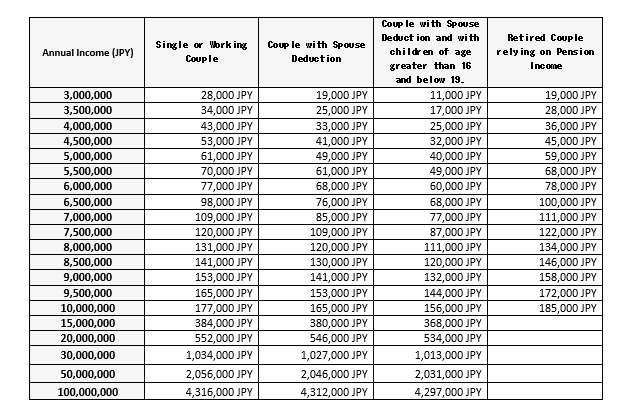
The amount that you can donate will depend on your tax bracket and on other tax credits that you might already be claiming. The below are very rough estimates but they should give you an idea of how much you can expect to claim based on your income tax bracket.

(SOURCE: https://www.furusato-tax.jp/about/simulation#simulation-detail-link-pc)

There are several websites that offer online simulators to help you calculate the exact amount that you can donate. Here are a few that I recommend:

Good Simulator in English

https://en.furumaru.jp/info/simulation.php

Detailed Simulator in Japanese

https://www.furusato-tax.jp/about/simulation#simulation-detail-link-pc

How does it work?

Assuming you went through the above simulators and you have the amount that you want to donate, you can check online shops that allow you to order Nozei Gifts. The below are just some examples that I’ve picked:

  • A website in Japanese that provides a ranking of popular Nozei Gifts.

https://furunavi.jp/ranking_total.aspx

  • This is the one that I have been using. Unfortunately, it’s only in Japanese but it provides a good selection of products and a user-friendly interface.

https://www.furusato-tax.jp/

These are just a few examples but you can type Furusato Nozei in to any search engine and you will come across numerous results.  You will be able to order a wide selection of items:

  • Fruit and vegetables from local prefectures
  • Holidays to visit your chosen prefecture
  • Alcohol
  • Clothes
  • Pottery
  • Sweets

And the list goes on. 

Don’t forget to pay by credit card for that extra bit of value.

I have a Rakuten credit that gives me 1 point for every 100 JPY spend. So if I donate 100,000, that’s 100,000 * 0.01 = 1,000 JPY which is nothing to be sniffed at, plus my yearly Furusato Nozei spend helps me maintain Platinum status on my card which comes with added bonuses.

Will I need to file a Tax Return (確定申告)?

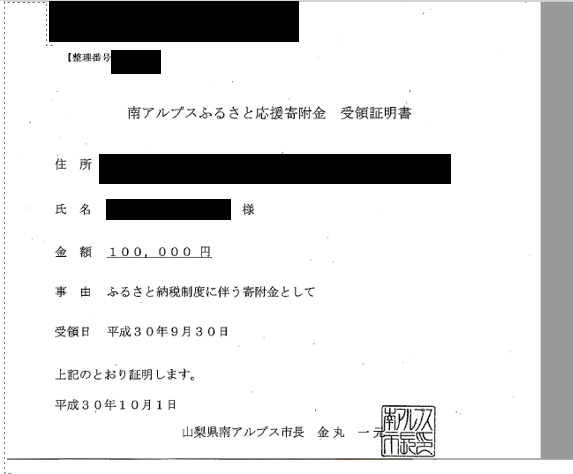
You can use the “One Stop Special Exemption” instead of filing a Tax Return. When you pay for your gift the prefecture will send you a thank you letter via post in addition to proof of your donation. Ensure to keep this in a safe place as it might be required in the future. In addition to this, you will also receive a form that will allow you to request the “One Stop Special Exemption”. Basically, if you tick yes to this and send the relevant documents, the prefecture will automatically declare your donation to your local tax authority so you don’t need to declare it yourself. The relevant documents are: (1) a scan of your My Number Card/Notification Card (2) a scan of an authorised document (passport, resident card, insurance card etc.), you will see in your form what documents are allowed so make sure to read that to avoid having to send documents back and forth. To note that if you have to file a Tax Return for other purposes (which was my case), you WILL need to declare your gift in order to get your tax deduction. This is when your proof of donation document is required. If you declare your donation in your Tax Return you will need to post the original certificate of receipt for your donation (make sure to take a scan before sending the original). I have scanned below the receipt that I got so you can see what one looks like:

Now that you have done the hard work, the next step is to enjoy the gifts that you will receive via post. As for the tax deduction, you will reap the rewards in the form of a tax deduction from the income tax and resident tax in the following fiscal year.

I hope you find this post useful and if you have any questions please feel free to post them in the comments section. Thank you for reading.