The World Quant University (WQU): Application and Overview

A free MSc in Financial Engineering sounds crazy but it looks like this is exactly what World Quant University seems to be doing. With an ethical goal of making education globally accessible to capable students, regardless of their financial situation, WQU launched their programme in 2015 by Igor Tulchinsky and has been gaining popularity, especially in the past few years.
The course is fully provided online and covers a wide range of topics/subjects that would be taught on a Masters in Financial Engineering.
Continue reading

Working with recruiters (as a candidate)

As a financial professional, you will reach that stage in your career where you start getting emails and calls from recruiters regarding new job opportunities. What do you do? How can you best maximise your interactions with recruiters to achieve your career goals? I am writing this post as someone who who has benefitted a lot in landing jobs via recruiters, so I am keen to share my experiences with you.

Continue reading

5 Popular Stocks in Japan that Offer Yutai Gifts (July & August 2020 Update)

In this post I will present to you my yutai stock picks for July and August 2020. It’s worth noting that July wasn’t a yutai heavy month, especially compared to August and September. Yutai investing might be fun but without wanting to sound too repetitive, I always like to add as a disclaimer that you shouldn’t just pick a stock solely because of its yutai. Rather yutai should just be considered as a perk in addition to the underlying return opportunities that the stock presents. Needless to say, given the uncertainty surrounding financial markets and COVID cases rising in Japan, I would be cautious before making any new purchases.

Continue reading

My Experience in Joining a Toastmasters Club

This is a post for those people who are considering joining a Toastmasters club.
If you are not familiar with Toastmasters, I would summarise it by saying that it provides a structured format and friendly environment for people who want to improve their presentation skills. Toastmasters also allows its members to get hands-on experience in organising and conducting meetings so time management and hosting skills can also be developed. This official Youtube video provides a general overview of how these sessions are planned and what responsibilities each member can take during the events. I only joined two months ago and I would like to share my experience with you so that you can evaluate if this is something that you might want to get involved with.

Continue reading

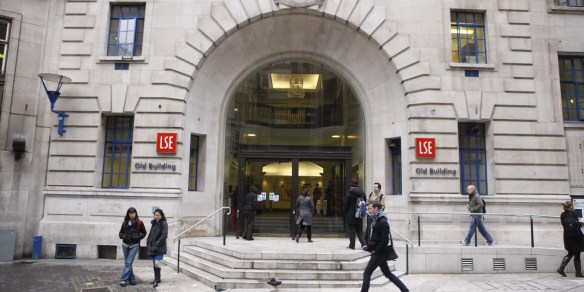
LSE Masters in Finance (full-time and part-time) Part 1: The Application Stage

Introduction
This post will cover LSE’s MSc in Finance and it will be divided into 3 separate parts: (1) Application Stage (2) Year 1 (3) Year 3.

Having graduated from the course myself, I would like to share some information which prospective students might find useful in evaluating the course prior to applying. As a disclaimer, I have no affiliation with LSE and with the exception of the factual information regarding the course, most of the content represents my personal opinion.

Continue reading

5 Popular Stocks in Japan that Offer Yutai Gifts (June 2020 Update)

A year ago I posted Top 5 Popular Stocks in Japan that Offer Yutai Gifts where I shared a popular list of yutai stocks. Given the interest received for that post, I created an updated list for 2020 that I would like to share with you. Some of my picks remain unchanged and it wouldn’t be interesting simply just re-introducing the same stocks so I will be doing something slightly different. Rather than ranking the “Top” stocks, I will introduce to you 5 stocks that pay out interesting yutai gifts.

There is a lot of material in Japanese, very often promoted by online brokers or other blogs and newsletters, but I couldn’t find a lot of content in English which is what led me to start this series of of posts.

Continue reading

The FRM Exam

GARP

The FRM which stands for “Financial Risk Manager” is a designation awarded by GARP (Global Association of Risk Professionals). The qualification is highly respected by risk practitioners and provides candidates with a solid understanding and appreciation for the subject of risk management. Exams are held twice a year in May and December. In this post, I will introduce the exam, talk about some study resources that I used and my experience in obtaining the charter.   Exam Structure The exam is multiple choice and it’ composed of two parts, each one lasting 4 hours. Part 1 consists of 100 multiple choice questions and tests candidates on foundational topics in risk management. Part 2 instead looks to extend the knowledge gained in Part 1 and focuses on the application of these concepts.   Exam Topics and Weights Part 1

  • Foundations of risk management (20%)
  • Quantitative analysis (20%)
  • Financial markets and products (30%)
  • Valuation and risk models (30%)
FRM Pie 1

  Part 2

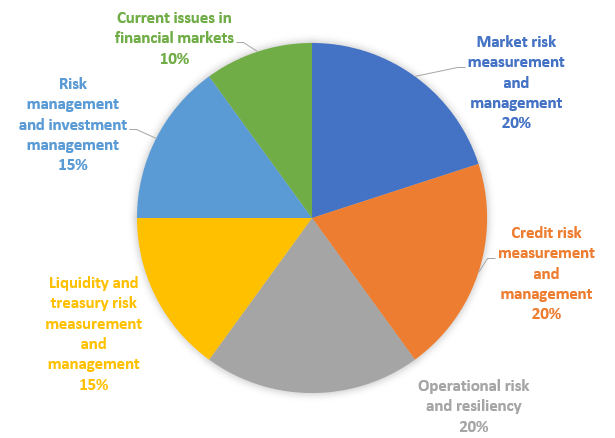
  • Market risk measurement and management (20%)
  • Credit risk measurement and management (20%)
  • Operational risk and resiliency (20%)
  • Liquidity and treasury risk measurement and management (15%)
  • Risk management and investment management (15%)
  • Current issues in financial markets (10%)
FRM Pie 2

  Please note that the weights have recently changed so if you have been using 2019 material you might want to look at recent changes in topics and weight to give yourself the best chances in passing the exam. The following article does a good job of summarising the changes for part 1.     Pass RatesBionic Turtle provides a table and graph of pass rates from 2010 to 2019. A ten-year average pass rate is calculated from the 20 exams, resulting in an average pass rate of 45.9% for Part 1 and 58.6% for Part 2.   Requirements for FRM Charter Passing both levels and demonstrate two years of relevant work experience to qualify for the designation.   Study Resources In preparing for the exam I used to study resources by the following training providers (please note that I am not affiliated with any of these companies):   Schweser

  • Similar to the CFA materials, the materials are well structured in highlighting the key points
  • A ton of questions and mocks to practice from

Bionic Turtle

  • Videos are very visual and easy to follow
  • Specialised in FRM and questions were of good quality

        Whether training providers are worth it or not, depends on your current background and time commitments. While it’s not impossible to pass the exam with just the official GARP textbooks, training providers will be able to help you focus on passing the exam by focusing on the key topics with short, clear and concise summaries. I personally think training providers provide decent value so if you are able to get any good deals (pass guarantee deals) or if your employer is paying for the material, you should definitely consider using these additional resources.   Difficulty, My Experience, Etc. Similar to any professional financial designation, I would say that the difficulty of the exam is very subjective based on your exposure to the concepts which are covered on the exam and your background. If are completely new to Var, Expected Shortfall and a lot of the basic concepts that pop up on the exam I would put in a solid 200-300 hours   Exam Strategy A lot of the advice that I give in my posts about the CFA exams also applies to the FRM exam. Exam taking techniques are very important in these types of professional qualifications and the most important points can be summarised in the following bullet points:

  • Having a clear strategy for scoring points on the exam: Take a few mock exams and asses your ability and check if your current areas of strength are sufficient to get a pass.
  • Time management before and during the exam: make sure to have a disciplined schedule in preparing for the exam. Bring a watch to the exam and make sure you are pacing yourself to avoid running out of time.
  • Eat healthy, exercise and stay in good shape to ensure your study hours are productive.
  • Enjoy the journey.

Some questions/remarks that I come across very often about this exam   Isn’t the maths on the exam very advanced? A lot of the statistics and probability on the exam might be intimidating depending on your background but I don’t think the maths tested on the exam constitutes a barrier in taking the exam. In my opinion, a lot of the concepts that are tested look for a general understanding from a generalist practitioner’s perspective.   How long do you need to prepare for the Exam? If you are a financial professional or a student who has already had a lot of exposure to the topics that are covered, I think 100-200 hours (per level) are a good estimate.   Should I take both levels 1 and 2 in a single sitting? It will depend on the time and dedication that you can afford to spend on this exam. I personally recommend taking levels 1 and 2 on different sittings (which is what I did) but if are scoring solidly on the mocks and you feel ambitious enough then go for it. However please be aware that if you were to pass level 2 but fail level 1 you would have to re-take level 2 which is not ideal.   Job Prospects I guess this is a very important point that a lot of prospective candidates are interested in. I can speak based on my 10+ years of experience in the financial sector and having been both a hiring manager and an applicant.  

  • I don’t think the exam holds the same weight as the CFA Charter or a master’s in financial engineering or Risk related subject from a prestigious uni. Also compare to the CFA, which is broader, people have the perception that FRM is only limited to risk management (to a certain extent they are correct).
  • Within Risk or Risk related areas, the qualification holds a solid weight and proves to employers that the candidate has a general understanding of the core topics within risk in addition to awareness of key regulatory events within the industry.
  • Just like any other qualification though, it is not the sole indicator of your ability to do well in the job so it won’t be your golden ticket to your dream job within risk.

Having looked at LinkedIn, eFinancialCareers and other job sites, the impression that I get is that jobs which have the FRM qualification seem to be concentrated within Market Risk. Quoting Schweser: Certified FRMs are most likely to be risk analysts, risk managers, credit risk analysts, market risk analysts, regulatory risk analysts, operational risk managers, or risk chief officers. With the exception of risk chief officers (yes, I need to improve my network) this statement is fairly accurate. Conclusion If you are working within risk and you are looking to cement your knowledge of the subject and looking to add to your CV, I would strongly recommend taking the exam. Compared to the CFA exam I believe that the effort/reward ratio for this exam is higher and I have started seeing more job postings that list FRM as a good to have under candidate requirements. Some Material that I found useful regarding the EXAMhttps://crushthefinancialanalystexam.com/frm-exam-dates/ A good overview of key exam dates for 2020. https://www.frmquestionbank.com/garp-frm-pass-rate/ This article outlines some of the reasons why FRM pass rates are low so it’s definitely worthwhile reading to avoid making some of the most common mistakes that candidates make. I personally think: 4 Waiting too long to start studying, 10. Not using enough practice tests and 11. Passing easy practice tests leading to over-confidence are the most common pitfalls.

Trying out a Robo-advisor in Japan

cute-807306_1920

Robo-advisors have increased in popularity in the past years but are they worth it? I was interested in seeing what they had to offer so I decided to try one out myself to see if these products are viable solutions for people looking to invest for their retirement. For those of you who are new to Robo-advisors, Wikipedia defines them in the following manner:


Robo-advisors or robo-advisers are a class of financial adviser that provide financial advice or investment management online with moderate to minimal human intervention. They provide digital financial advice based on mathematical rules or algorithms. These algorithms are executed by software and thus financial advice does not require a human advisor. The software utilizes its algorithms to automatically allocate, manage and optimize clients’ assets.


Below I have listed a number of popular Robo-advisors in Japan (the list is based on Robo-advisors that I looked up on 7th May 2020 and is not an exhaustive list).


  1. WealthNavi
  2. Theo
  3. On Compass
  4. Folio
  5. SMBC Robo Advisor


After reading about a number of Robo-advisors, I ended up choosing WealthNavi which seemed to be one of the most popular brands in Japan. The services that all the above brands offer seem to be all comparable where they charge around 1% for an account that invests in a diversified portfolio and performs rebalancing and optimisation.


How it works?

Once you set up the account and login you will be asked to start a questionnaire for the Robo Advisor to assess your risk/return objectives. For WealthNavi there are a total of 5 categories, with 1 being the most conservative and 5 being the most aggressive. The investment universe is limited to the below ETFs, however based on your risk appetite you will see a greater/smaller allocation to stocks. Here are the ETFs that your account balance will be allocated to:


VTI: Vanguard Total Stock Market ETF

https://investor.vanguard.com/etf/profile/VTI


VEA: Vanguard FTSE Developed Markets ETF

https://investor.vanguard.com/etf/profile/portfolio/vea


VWO: Vanguard FTSE Emerging Market ETF

https://investor.vanguard.com/etf/profile/VWO


AGG: IShares Core US Aggregate Bond ETF

https://www.ishares.com/us/products/239458/ishares-core-total-us-bond-market-etf


GLD: SPDR Gold Trust

https://www.spdrgoldshares.com/


IYR: IShares US Real Estate ETF

https://www.ishares.com/us/products/239520/ishares-us-real-estate-etf


TIP: IShares Tips Bond ETF

https://www.ishares.com/us/products/239467/ishares-tips-bond-etf


All ETFs are well known, provide good exposure to the market/asset class that they are looking to track with a very low expense ratio. I have added above the links to the fund profiles for those interested in looking at price/performance, fees, distributions, etc.


A Sample Allocation with a risk tolerance of 5.


(Allocation for 26th July 2019, initial investment 1,000,000, weights rounded at 2 decimal places)

Name Ticker   Weight
US Stocks VTI 358,896 34.28%
EU Stocks VEA 346,262 33.07%
Emerging Market Stocks VWO 148,698 14.20%
US Bonds AGG 50,297 4.80%
Gold GLD 87,136 8.32%
Real Estate IYR 50,750 4.85%
Cash   4,969 0.47%


Fees: 1% annual fee on your invested balance (excludes your cash weight), for investments over 30MM JPY 0.5% (SOURCE: https://www.wealthnavi.com/).


Rebalancing Frequency

WealthNavi’s algorithm is set to perform rebalancing every 6 months. However, if any asset class deviates from its optimal allocation weight by more than 5%, rebalancing takes place ahead of schedule to bring the portfolio back to the optimal allocations. For rebalancing to take place ahead of schedule please note that you need a minimum balance of 500,000 JPY invested in the account, if your deposit is lower than this amount you will need to wait until the next rebalancing date for the portfolio to be rebalanced back to its optimal allocation.

(SOURCE)

After trying the service, I was able to come up with the following advantages and disadvantages from using Robo Advisors.


Advantages

  1. Automatically generates an allocation based on your risk tolerance

Arguably, one of the main reasons why people choose Robot-advisors is because allocations and rebalancing decisions are done automatically based on pre-defined rules and algorithms with some form of portfolio optimisation taken into account.  This is a great advantage if you want to avoid the hassle of having to review your portfolio and having to regularly update the allocations yourself.


  1. No Transaction costs when rebalancing portfolios

Buy/Sell orders in your brokerage account will usually result in transaction costs, however rebalancing done by your Robot-advisor will not result in you incurring these fees. You will be charged a flat fee as a % of your account balance.


  1. Tax-efficient rebalancing

The optimisation algorithm (at least for WealthNavi) is able to factor in taxes when realising gains/losses and offsets them to ensure steady returns whilst minimising tax liabilities.


Disadvantages


  1. High Fees

Arguably, the fees that Robo-advisors charge is one of the biggest drawbacks from this service. Especially if you are paying 1% to hold a balanced portfolio of ETFs this is something that you might want to consider doing yourself if you are able to sit down, measure your risk appetite and do some analysis based on your risk return objectives. There are a lot free softwares out there that perform portfolio optimisation. There is a limit to the transparency that each Robo Advisor will provide in terms of rebalancing rules (especially if this will end up revealing trade secrets) but from what I can gather is that a lot are based on Modern Portfolio Theory and will place your portfolio somewhere on the efficient frontier based on your risk/return constraints.


  1. Value lost from automation/not too much customisation

Some of the value that financial advisors can offer is the tailored financial advice they can give to individuals based on their financial situation and objectives. The bucketing and categorisation that current Robo-advisors perform is still limited in my opinion and is not able to capture the cognitive aspects and intricacies of the investor’s mind.


Conclusion

I believe that the value of Robo-advisors depends a lot on how much time you want to spend in looking at your portfolio. If you are just happy to have your money invested automatically in a diversified portfolio and want to spend minimum time and effort in working out portfolio weights, buy/sell timings I do see a value in this service. If instead you are happy spending some time reviewing your allocations and making your own investment decisions, I believe that spending additional fees on a Robo-advisor just ends up hurting your returns and you have much cheaper ways for obtaining comparable results. There are also a lot of ETFs out there which already provide a very good level of diversification at extremely competitive management fees.


Trading FX

I have been trading FX for 3 years now and as I am starting to become profitable in my trades, I would like to share with you some of my findings to help newer traders avoid some of the common mistakes that I made. I strongly believe that people following the below points should be able to move away from the 90% of losing traders and join the 10% of profitable (or breakeven) traders.
By all means, this is not a post that will transform you into advanced traders overnight, but it summarises a lot of sound advice that I came across during my journey as a retail trader.

Find the right broker
Having tried many platforms, I soon realised the importance of working with an interface where you are comfortable making trades. You will be spending a lot of time staring at charts, so you want to ensure that the platform is pleasant to use and well-equipped with all the tools that you need. I believe that the below criteria should be satisfied:

  • Good charting, ability to customise and plot all the technical indicators that you need
  • Speed of execution (I realised the importance of having an execution system where you can swiftly adjust stop losses, take profit levels as price moves)
  • Notification/Alerts: I have learned the importance of using alerts that notify you when certain technical indicators are breached so that you don’t have to stay glued in front of the screen the whole time

In selecting a broker, you also want to ensure that you check what spreads your broker is charging. The higher the spreads, the more this will erode your returns. Brokers that are accessible to you will depend on the region where you are based but for Japan at least there are numerous comparison websites for a) spreads b) swap points, between different providers.
The spread refers to the bid-ask spread that your broker is quoting you. The higher the spread, the higher disadvantage you will have when entering and exiting trades. The swap rate instead is the interest rate differential between the two currencies; for example, if you are selling JPY which has low interest rates and buying USD which has higher rates, you will have a positive carry and swap points will be added to our account on a daily basis.

Identify what kind of trader you are
There are different type of trading styles and such styles are mainly based on the frequency of trading and holding time period. Traders can be classified as Scalpers, Day-Traders, Swing Traders, Position Traders. Whilst scalpers might enter into numerous trades throughout the day in the attempt of making few pips in each trade, Position Traders who are on the other side of the spectrum, will hold onto positions for months as they seek a longer-term price movement in their favour. It is important to understand where you fit as a trader as this will dictate your position sizes, stop losses and take profit levels.

Stick to a few currency pairs
They say that each currency pair is unique and has its own characteristics and I couldn’t agree more with this claim. In my case, I have been focusing on GBPJPY (one of the most volatile pairs as this pair is very sensitive to global risk appetite). As I have been gaining more and more experience in trading this pair, I have been getting a feel for how it tends to move, how news announcements affect it, and at what price ranges it trades. You must develop that gut feeling for the FX pair that you are trading and this is difficult to do if you spread yourself thinly on several pairs.

Treat your losses as educational fees
Losses are an inevitable part of the game; you are betting on an uncertain outcome so there is always a possibility that price might move against you and you will have to realise a loss. When you are in a losing position if you have set up a disciplined and rules-based trading system, you should have a stop loss and your trade should have already been closed. If you haven’t set a stop loss (which his not advisable) and you are in a position where you need to make a decision. I have been in this situation multiple times, especially in my first months of trading. I kept thinking that the price would eventually move back in my favour and let the trade play out. I can guarantee to you that this is how you will accumulate massive losses so as hard as it might be to depart from your hard-earned cash, learn to cut your losses short and prepare to fight future battles. A good way to help you cut your losses is to treat them as fees that you pay to learn, it is very important that you analyse the outcome of that trade to avoid future mistakes.

Setup stop losses and think in terms of Risk & Reward Ratio
I already briefly mentioned this in previous paragraphs, but this is so important that it deserves its own section. Stop losses are there to protect your whole capital when the price moves against you. It’s fine to lose trades here and there, what will keep you in the game is to be making money on average after considering a large number of trades. This idea of expected trade winnings is very important and links perfectly with the concept of Risk & Reward Ratio. In very simple terms, you are telling yourself, how much money you are willing to risk to make a certain amount. Let’s say, you are looking to enter a trade that can make you 30 pips and you set up a stop loss of 10 pips, then your Risk & Reward Ratio is 30/10 or 3. You need to start thinking of trades in terms of expectations rather than looking at individual winners or losers. Before I enter a trade, I always ask myself if the trade has a positive expectation. If it does, this helps me realise my losses quickly so that I can enter into new trades that will more than offset the losses and make me profitable in the long run.

Keep your strategy simple
When I initially started trading FX, I thought that profitable traders had sophisticated charts, arcane entry signals and complex algorithms. As I started researching profitable strategies and following successful traders, I quickly realised that this belief couldn’t be further away from the truth. A lot of the strategies are very simple and require discipline and patience in the execution but are proven to be very effective. Strategies are important but they must be adapted to people’s unique trading styles and must be coupled with rigorous risk management.

FX is a mental game
When I tell people that I trade Forex very often I am told that it’s very risky. FX is risky only if you trade with no clear strategy, let your mental emotions take over and overleverage. If you approach FX in a disciplined and methodical way it has the potential for being very profitable. My advice to take control of the mental game is to start trading small amounts and learn more about yourself. Play money won’t be a good indicator so be sure to start with very small amounts that you can afford losing. As you start testing your strategies and start becoming profitable, start increasing your position sizes to a level where you feel comfortable. If you over-leverage, you will end up making decisions that are driven by emotions rather than sound rational rules.

Keeping Track of your P&L and entry/exit decisions
I would like to conclude with the most important piece of advice. I strongly advise that you keep a diary and document your trading decisions in addition to keeping a spreadsheet where you calculate your P&L. This will help you identify mistakes and help you adjust your trading plan to achieve longterm success. From personal experience I can say that the below are some of the most common mistakes that I was making:

  • Bad entries
  • Keeping positions open before major economic announcements
  • Trading when volume is low
  • Increasing the sizes of my positions and taking too much risk on single trades
  • Not setting stop losses

Conclusion
This post was aimed at people who are about to start their FX trading journey. For those who want to be successful trading FX, they need to treat it like a business, listen to expert advice and devote the required hours to become proficient in executing their strategies. If approached correctly, FX has the potential of helping people to achieve financial success, approached in the wrong way FX is on the par with gambling and can lead to big losses.