Getting Technical with the CQF (Certificate in Quantitative Finance)

CQF

This is a programme that I had been looking at for a while; the course seemed to be very well structured and geared towards people like myself who are interested in learning about the building blocks of quantitative finance in a short amount of time. The course has renowned lecturers such as Paul Wilmott who is very well respected within the quantitative finance community. 

Information regarding this programme can be accessed here.

A bit about myself 

Before delving into the course details I would like to give some context as to why I thought this course would be beneficial for my career. I have around 10 years of experience working in the financial sector and 5 years in derivatives valuations; although I heavily rely on industry-standard pricing models, very rarely do I need to look into the derivations of such models. Although some might argue or question the practicality of delving deep into understanding SDEs, Martingales and Risk Neutral Measures, these are all topics which have been fascinating me for a while and I have always found understand them hard to understand via self-study. I don’t have a maths/physics background so before even starting with stochastic calculus, I was struggling with the basics. My goal was to develop my skills which would allow me to take a stab at an entry-level quantitative research role and progress my learning experience via a PhD (in Financial Engineering); I thought the CQF would be a good starting point and would equip me the necessary skill set.

Before the Course

If you are reading this post, chances are that you are in a situation similar to mine 6 months ago. You might be asking if this course is worth it or if there are any other cheaper and better alternatives. With a price tag of around $16K, it would be foolish to enrol on the course without any proper research. $16K is also an amount where you start thinking whether it would be just better investing a little bit more to be able to get a Masters in Financial Engineering from a prestigious institution. Having done a fair amount of research myself and having gone through the ongoing debates on Quantnet, these were the key discussions that I was seeing on the forum.

For those who have concluded that the CQF does not warrant its tuition fees and instead are just looking for some good textbooks, I can recommend the below: 

– Steven Shreve, Stochastic Calculus and Finance. http://efinance.org.cn/cn/FEshuo/stochastic.pdf

– Interest Rate Models – Theory and Practice: Damiano Brigo, Fabio Mercurio.

– Options, Futures and Other Derivatives: John Hull (this one is a classic) 


I could write a longer list but these are the core textbooks that I found particularly helpful.

The CQF also discloses online its core textbooks, so self-studying those materials might also be an option if you already have a certain level of maths (Paul Wilmott Introduces Quantitative Finance, is what I would recommend starting with to grasp the basics).  https://www.cqf.com/about-cqf/program-delivery/learning-resources

Course Structure and Overview 

London based students can attend classes directly. However, since most students are based outside of the UK, they will view the classes online via the learning portal. During the live webcasts, students have access to the chat functionality and can ask/answer questions. All classes are recorded and available on the portal so that delegates can view them at their own pace. 

The whole course is divided into 2 levels and the topics covered in the respective levels are as follows: 

Level 1: Building Blocks of Quant Finance, Quantitative Risk and Regulations, Equities and Currencies

Level 2: Data Science and Machine Learning, Fixed Income, Credit, Advanced Electives

(please note that this information is accurate for the June 2019 Cohort which I enrolled for) 

In my case, I had 2 exams at the start of Level 1each counting 20% towards the final score of the course and 2 more exams for Level 2, another exam counting 20% and the final project counting 40%.

All exams are open book and except for the final project, you have two weeks to complete each exam. In designing these exams, the CQF has focused on the practical part rather than testing whether delegates can just merely memorise formulae and concepts. I found the projects fun and rewarding to do. Without giving away too many details, here are the topics that I was tested on:

Exam 1: portfolio optimisation and VAR / Exam 2: option pricing exotic options / Exam 3: machine learning and fixed income pricing / Exam 4 final project (you have a range of topics to choose from).

There is also a final optional exam that you can take if you want to aim to get a distinction on the course.

Tips for people who already signed up

If you have already signed up and you are eagerly awaiting to start the course I have a few tips for you which I hope you will find beneficial in your journey. 

Tip #1 Do the maths primer

This is also very strongly encouraged by CQF faculty. A lot of the maths that is used relies on: algebra; statistics; and calculus. You will have a hard time-solving PDEs and SDEs if you are rusty on the basics. Be sure to to be comfortable with these topics if you don’t want to quickly fall behind; you should attempt the optional test to gauge your skills.

Tip #2 Choose Python as your Programming Language

Assuming you are looking to pick up a new language, I recommend using python as a lot of the course material and libraries use python. R might also be a good alternative. If you are already comfortable with a programming language then stick to that one, this advice applies to candidates who are not very advanced programmers and who are beginners in numerous programming languages (this was my situation at the start of the course).

Tip #3 There is no shame in asking for an extension for your projects

I assume that a lot of the people are working professionals which adds an extra layer of difficulty in meeting assignment deadlines. You are allowed one extension per exam for each level so you should take advantage of this to ensure that you have enough time to submit good quality work. Please note that if you don’t defer an exam and miss a deadline, you will automatically be deferred to the next cohort so it’s in your best interest to respect the deadlines if you want to complete the course in 6 months.

Conclusion

I think a lot of people might be interested in reading the conclusion. Is this course worth taking or not? I can’t provide a clear yes or no answer (I’m sorry) as I have still not completed it. What I can say at this stage is that taking the CQF made sense for me as I had been struggling a lot in picking up the required entry-level maths for a quant role. The course breaks down quantitative finance into its core areas, which helped me to grasp the basic concepts and taught me to apply them in a practical manner. My aim now is to continue working on the skills that I learned and build a portfolio of research strategies and papers whilst developing my personal views and awareness regarding this fascinating discipline.

I will list some positives and negatives that should give some more colour regarding my experience.

Negatives

– Since the classes take place during London evening hours, this ends up being very late for APAC based delegates. Due to the time difference, I ended up watching the recordings when I would have preferred being able to participate in the live classes without staying up late.

– The course did feel a bit pricy given that it only lasts for 6 months and it felt a bit rushed. I know deferring for 6 months is an option that candidates have but I thought that the content could have been spread out a bit better.

– Although overall the level of teaching was good, I saw huge gaps between the level of teaching by certain lecturers which impacted my learning experience for certain topics (this is an opinion shared by a number of delegates who I spoke with).

– A lot of people still question the rigour and I personally don’t think the CQF at this stage will hold the same weight as an MFE or PHD when applying for quant jobs. I am interested in how the CQF Institute will continue working on the brand in the upcoming years.

Positives

– The course definitely taught me a lot of maths and practical skills which I have found useful at work. This is what I was looking for so I can say that the course delivered what it promised.

– I really enjoyed using the CQF app. Being able to view videos during my commute to work helped me continue my studies, especially during busy days.

– The video library is pretty decent and I will be looking at the additional lecturers in the upcoming months. This concept of life long learning does appeal to me.

– It has a good focus on coding and I will be aiming to spend the following months in testing what I have learned. I felt like the course gave me the required tools to start doing my own research within the field of quantitative finance.

I hope you enjoyed this post and if you have any questions please feel free to email me privately. Good luck with your studies!


Disclaimer: Please note that I am not affiliated with the CQF Institute, the above content represents my subjective views about this course. This post was written to help people make informed decisions about the CQF programme, I strongly recommend that you do your own research prior to signing up. 

How to Avoid Getting Ripped-Off on your Currency Exchange

Before I get started, please note that I am not affiliated with any of the products mentioned in this blog. I am just an individual who was fed up of getting bad exchange rates and decided to do some research and I would like to share my findings with you. You might be able to find some better deals, in such case I strongly encourage you to share them in the comments section so other readers can also benefit.

This article is aimed at individuals like me who are based and work in Japan and who are looking to convert their hard-earned JPY into a foreign currency and get a decent rate. The main reason why I started looking into this was to purchase some travel money for my upcoming trip to the US.  Another reason was to be able to build up some savings in EUR and GBP and convert at a good time.

My Requirements

My extended trip to America was approaching and I started doing some research to get good value in buying dollars. I am aware that the spread for USDJPY is narrow and that even when you get a sub average deal the commission is borderline negligible (especially when converting small amounts for travel money), however this time I wanted to find some providers that would allow me to get decent rates in future transactions.

When travelling, I decided that I wanted to have a portion of dollars in cash and have the flexibility of paying by credit card.  I wanted to:

–       Avoid getting rubbish rates when converting to cash or when getting charged on my credit card

–       Avoid getting additional credit card fees when paying via credit card

–       Have some flexibility in watching the FX rate and converting at a good time

Getting Cash

I initially started by looking at physical shops but I soon realised that online FX brokers were the most competitive ones in terms of the spreads offered. An interesting service that really appealed to me was the ability to buy dollars at online broker FX rates and to have the cash delivered to the airport. For example, as of 29th October 2019, the spread for USDJPY is 0.3 pips which is really good. Compared to that, the banks tend to stick to TTM and TTB + commission (FX rate published by Bank of Tokyo Mitsubishi) which will have a spread of 100 pips for USDJPY. I am not even wasting your time with airport exchanges which will blindly rip you off.

The company that I liked is called “Money Partners”. Being an online broker, their focus is on providing FX trading services and CFDs, but what stood out to me at on their website was their “airport cash delivery service”

https://www.moneypartners.co.jp/

I have been trading FX for a while and I was also drawn to the fact that you can set a delivery date and in the meantime also pocket the swap rate which is non negligible when you are long (is that correct, idk what i means?) USDJPY (usually it’s about 60 JPY/day per contract). I don’t want to digress too much though from the primary purpose of buying travel money at a cheap rate.

With Money Partners you pay a flat fee of 500 JPY and can collect your money at the airport with the conversion rate being pretty much what you would get on your online FX brokerage account. You just go to the Travelex counter and Money Partners will have sent them an envelope with your cash (you need to collect the money by the designated collection date). I tried picking up my dollars at Haneda airport and the overall experience was positive; as soon as I got to the counter and showed my Partners Receipt the employee just asked for some form of ID and handed me the envelope (please note that the money will be taken out from the/your online brokerage account).

Sorting out the Card Part

In addition to cash I also wanted some flexibility in being able to pay by credit card. After looking online, I found a few blogs which recommended Sony’s Money Kit card.

This is a prepaid debit card which allows you to hold non JPY denominated accounts (ex. EUR, USD, GBP).

Info regarding this product can be found here:

https://moneykit.net/visitor/sbw/

This is how it works:

I pay abroad, let’s say in New York and pay via this debit card. If my USD balance is positive then the transaction will come out directly from the USD denominated account at no additional fee. The fee part was very important for me as a lot of Japanese card companies allow you to use their cards abroad but then to charge you 1-2% in fees.

If instead I only had JPY in my account Sony would have deducted the charge from my JPY account charging me a flat fee and converting at the prevailing spot rate. If the current exchange rate is favourable to you and you want to lock into it I recommend holding a reserve of foreign currency so that you can access that when you go abroad. Another positive in holding non JPY is that (with the exception of EUR) the prevailing rates will be higher (although you are taking FX risk so please be careful).

Lastly, another thing/something that is worth noting is that the Sony Card also allows you to withdraw cash abroad from ATMs. However, I did notice that usually local ATMs tended to charge you $4.50 for that luxury.

Taking the 2019 Autumn CMA Exam in New York

Over the past months I have been preparing for the CMA (Certified Member Analyst of the Securities Analysts Association of Japan) exam and although this is a Japanese exam, they have test centres in London, Hong Kong and New York.Since I had some holidays booked to visit the US at the end of September, I opted to take the test in New York and so in this post I would like to share my experience. 

Preparation

The exam is comprised of three sections: Accounting, Portfolio Management and Economics (you can read more about the structure of the exam here) and I had registered this time to take the Accounting portion since I had taken the remaining two parts in Japan. In preparing I made sure to go through past exam questions and practice questions. If you are enrolled for the exam you will have access to past exam papers from 2014 – from your MyPage Account. The below book by TAC is also widely used by candidates in their preparations; the book has the same past exam questions that you can access from your MyPage however the questions are neatly categorised based on topics and the answers are more thorough compared to what you will see from the institute papers. 

Having seen numerous solved past papers OR Having seen and completed numerous past papers, I can say that the format has remained unchanged for years so if you have done your prep you shouldn’t have/experience any big surprises on test day.

Here is how the exam is structured:

Part 1 (concept checkers: 17 questions) In this section you will get conceptual questions on ALL topics and there will be no calculations involved. You will pretty much know straight away whether you know the answer, or you should at least be able to narrow down your answer to make an educated guess. Unlike parts 2,3,4 this part is difficult to prepare for given the breath of the topics.

Part 2,3 (calculation questions: 15 questions) The calculation questions which come up in these sections are pretty repetitive so this part should allow you to pick up a lot of points. Lease Accounting, Tax, Pension Accounting, Equity Valuations, Inventory Accounting are some of the most popular topics tested in this section. 

Part 4 (financial statement analysis: 26 questions) In this section you are given a Balance Sheet and an Income Statement and you are asked to calculate a lot of financial ratios. Be sure to know how to calculate ROE (Du Pont Analysis), ROA, Efficiency Ratios, Safety Ratios, etc..  

Please note that just like the other level 1 exams the entire Accounting Exam is also multiple choice based.

My Strategy

I did a lot of research to see how people tackled this exam and a lot of candidates recommended tackling the exam in the following order: Part 4, Part 2,3 and lastly Part 1. The format for Part 4 has remained unchanged in the last years so as long as you remember the formulas for the ratios and where to look for in the financial students for the relevant information, you should be able to get most of the points. When calculating ROE or any ratio that mixes income statements and balance sheet items, remember to take the average of the two fiscal periods for balance sheet items. For example, if you are calculating ROE (Net Income/Equity) for period T, make sure to calculate the Equity part in the denominator as Equity = (Equity_T-1 + Equity_T)/2.

Other than that, the rest is a lot of number crunching so being able to quickly compute ratios on your calculators should be very helpful. For the exam I chose to use the HP12C calculator which I also used throughout my CFA exams. I focused most of my energies on this part and aimed to get 100%.  

Parts 2 and 3 have a bit more variety compared to part 4 but these questions should have popped up in past exams. I stepped in the exam room aiming to get around 70%+ in this section. 

Finally, we come to Part 1 or I should call it the ‘wordy concept checker’ section which no one seems to like, myself included. Assuming I got most of my points from the remaining sections, I didn’t bother spending too much time here and aimed to get around 50% 

Exam Day

Exam day was a perfectly sunny day, a day I would have preferred enjoying in Central Park rather than taking a Japanese financial analyst exam. The test centre was at the Silberman School of Social Work in East Harlem and my hotel was close to Time Square so I ended up getting the NYC metro from the Grand Central Terminal.

I had taken the exam in Tokyo and sitting it in Harlem it was a completely different experience compared to sitting the exam in Aoyama Gakuin or Waseda. New York was much less chaotic, and I was surprised to see that only 5 other candidates were taking the exam. Slight jet lag aside, I thought it was quite a fair exam and I stuck to my strategy of solving the numerical parts first and leaving the wordy Part 1 until last.

Although I have not yet received an official email from the institute, based on past years we can I expect results to come out in the first week of November. I felt very relieved after the exam and I did manage to go and spend some time in the sun enjoying Central Park.

Japan Investment Conference 2019: The Multi-Stage Life and The Challenges Facing Financial Services

This is an event that I attended a couple of weeks ago and the agenda can be found here:

Click to access JIC2019_agenda_EN.pdf

This was a special event as it was also an opportunity to commemorate CFA Japan’s 20 year anniversary. The topic which was chosen was also interestingly titled “The Multi-Stage Life and The Challenges Facing Financial Services”; this deviated from past topics that the society had chosen and there were a lot of people expressing their opinions that this was more aimed at individuals and wealth advisors rather than your traditional institutional investors. Nevertheless I thought the event was a success.

Out of the speakers, Dr. Andrew Scott from the London Business School was one of the main speakers and his presentation was based on his book “The 100-Year Life – Living and Working in an Age of Longevity”. Other presentations followed this theme regarding our longer life expectancies across countries and the need to prepare for a multi-stage retirement phase.

The ongoing debate regarding this trend up until now has been to consider working and retirement as a two stage process. You pretty much work all your life, put money on the side in terms of savings, state pensions and or private pensions. You reach 60 or 65 or whatever the retirement age is in your country and you tap into your pension pot and your assets during your retirement. Assuming a life expectancy of 85-90 that’s 20-25 years that your retirement pot needs to last. If you are looking at 30 years +, it simply isn’t feasible to to have such a large retirement pot. Governments need to get to grips with this reality. Financial service providers will undoubtably capitalise on this and more importantly, as individuals we need to be aware of this and plan accordingly.

Wealth as a Portfolio of Intangible Assets

This was a very important point that was brought up and changed the way I perceive the accumulation of wealth towards retirement. Up until now, I was only looking at retirement in terms of the cash inflows that you could get from your retirement pot (regardless of whether this is in the form of annuities or income from your portfolio). This could not be further from the truth; firstly, our health is a key asset that needs to be treasured, especially in retirement. A healthier life will also result in a reduction of medical bills. Another point worth noting is the earning ability which shouldn’t automatically go to 0 as we retire. As individuals are likely to lead a multi-stage retirement phase, we might see people in their 60s transitioning in other type of roles. For companies, it’s important to treasure this generation who will be abundant in the workforce. As individuals we need to keep aware of our earning abilities and ensure that our skillsets are still required in the current labour markets.

My Thoughts

Financial Institutions will inevitably need to perform a paradigm shift as we see this demographic change. From an asset allocation perspective, I am interested in seeing how individual portfolios will change to have slightly more aggressive allocations to meet long-term return requirements whilst addressing possible liquidity needs especially in retirement years. This is an area that I am very keen on and that I will be researching in the upcoming months. The solution might be that the level of risk might not be optimal for the individual. In such cases, we should look at longer working years to boost portfolio contributions. Overall I think the start is educating people and spreading awareness of this trend; we all need to be conscious that this is a change that we will see in our generation.

CFA Results Are Coming Out on 6th August 2019.

So, if you took the June exam, tomorrow is the day that you have been waiting for. Level 1 and Level 2 candidates across the the world will be receiving their CFA scores. Level 3 candidates will have to wait a bit longer. After 9:00 AM E.T. you will get an email from the CFA institute titled “Your CFA Exam Results” . The contents of the email will look like this:

From the first line you can tell straight away if you failed and the email should start with “We regret to inform you….”.

Myths regarding the timing when you receive your email.

The CFA institute says that you will receive your email after 9:00 AM E.T. and some candidates can expect to wait hours before they receive the email. When I was waiting for my exam results, constantly refreshing my inbox and reading forums, people were speculating that candidates who received their emails first had passed and candidates who received their emails later had failed. Over the years I have reached the conclusion that this is utter nonsense and that the order is irrelevant. I have come across both passing and failing candidates who received emails relatively early.

How to interpret the scores?

Unfortunately you will not get told the questions that you got wrong so you will have to look at how strongly you scored in the three bands (<=50%, 51%-70% >70%). Needless to say, if you have many <=50% chances are that you failed. However as I am sure that you are aware, not all topics are weighted equally so if you scored well in highly weighted topics such as equity and financial reporting that might have been enough to offset poor results in other areas. If you failed marginally, the important thing to do now is to identify your weaknesses and to focus on those areas when re-taking the exam, whilst retaining what you learned for other topics.

If you have failed on most topics, don’t despair. In that case, in addition to spending more time in preparing, I strongly advise you to review your study techniques. Exam taking strategies play a key role in the CFA exams so speak with friends who passed and see what worked for them.

I disagree with the marking.

Yes, if you failed marginally and you are confident that you should have passed, you can ask the institute to remark the exam. This will set you back $100 and chances are that things won’t work in your favour, although I have come across a few online posts where candidates were boasting of having had a fail result changed to a pass after asking for their papers to be remarked.

Preparing for the next level.

If you are thrilled that you passed and you want to leverage this positive momentum to get started in your preparation for your next exam, I recommend that you read the following articles where I provide some study tips for levels 1, 2 and 3. I will never get tired of saying this, although all levels share common themes and topics, the type of questions and skill sets required to succeed in each level differ a lot.

I would like to conclude this post by congratulating all candidates regardless of their results. These are not easy exams and only the people who have undergone the preparation and took the exam can understand the effort that it takes in passing. Having had the charter for roughly 3 years now, I am confident that you will reap the rewards of your hard work, so good luck with your journey.

Reviewing your Asset Allocation and Investing in Exchange Traded Funds (ETFs)

Recently I’ve been looking at my asset allocation and thought it would be a good opportunity to talk about exchange traded funds (ETFs). Just like common stocks, ETFs are traded on exchanges and allow you to invest in funds managed by professional fund managers which have a predetermined investment mandate and benchmark. Unless you have above average stock picking skills and you have been regularly generating alpha, my advice is to invest a sizeable part of your portfolio in a passive portfolio that tracks the market. In my case, I hold a long term positive view on the growth of the American economy, so over the years I have been stashing a considerable chunk of my savings in an ETF tracking the S&P500. The remainder of my portfolio is invested in ETFs tracking EMEA blue chip stocks, emerging markets, the global fixed income market, gold and real estate.   

My Financial Situation and Some Tips before you Start Investing

Before you even start considering investing in the stock market, make sure you are meeting more crucial needs which I identify as the following:

–          Paying off any credit card debt. This is self-explanatory, every bit of interest that is accruing is eroding your returns. Ensure to pay any credit card debt before investing.

–          Budgeting your monthly expenses and keep a safety reserve of cash so that if you lose your job or come across some unforeseen events you are prepared.

–          Checking if there are better ways in which you could use your money. Investing in yourself via qualification and courses might increase your earning potential and overall provide a higher future stream of cash flows.

–          Investing in your health. Your health is also an extremely valuable asset so don’t neglect it.

–  Paying attention to the cognitive part of your investment process. If you do decide to invest, make sure you are investing amounts of money that you are comfortable losing. Yes the economy has been in a long bull market but the odds are that eventually it will crash and you could see your portfolio take a huge hit. In such cases, you don’t want to be stressed out and liquidate your portfolio at suboptimal times. You need to be able to withstand such events from a mental and financial perspective and keep a mindset that invests for the long run. You need the discipline to research and implement a plan and to stick to it. 

As for me, I am in my 30s, in good health and my investment goal is to build my retirement portfolio giving me a long investment time horizon. I have put aside an emergency fund so all the money that I am investing I can afford to keep invested for years and years to come. I have decided not to buy a house so I am mortgage free at the moment and my main source of income comes from my full-time job. When looking at a very basic asset allocation between risky assets such as equities and safer fixed income instruments the rule of thumb is to take 100 minus your age, this would result in a 65% to 70% allocation in equities for my portfolio. In my portfolio I have included alternative investments such as real estate and commodities as it has been empirically shown that their low correlation with traditional assets enhance portfolio risk adjusted returns.

If I were to summarise the investment process

–  Identify your investment goal(s)

– Assess your current financial situation.

– Execute the plan in a cost-efficient manner (this involves looking for best execution)

– Monitor your plan and check and develop a feedback loop.

Pick the right ETF

Once you have done your research and you have developed your investment mandate in accordance to your goals and views it’s time to start screening for ETFs. Companies like Morningstar provide a rating for ETFs and a lot of brokers give a ranking of popular indices based on  trading volume which should help you familiarise yourself with the most popular ETFs. Having said this, it’s always best to perform your independent research rather than relying strictly on popularity and reputation. Once you’ve found an ETF that you are interested in, ensure that you read the prospectus. Have a look at what the index performance has been (although by all means these will not guarantee future performance). Look at the volatility to see if the asset satisfies your risk appetite. The below link is an example for (VOO), Vanguard 500 Index Fund ETF Shares.

https://personal.vanguard.com/pub/Pdf/p968.pdf

Also pay close attention to the investment fees that the ETF is charging, for a passive strategy that tracks the market you want to ensure that you are minimising your fees so that they do not erode your returns. If you are looking at an active strategy that has the potential to generate alpha then you can start considering paying higher fees.

You should also check historical payment of dividends and see what yield the index is generating, such dividends are far from being negligible and constitute a core part of your total return. You can also opt for total return indices where dividends are automatically re-invested rather than being paid out.

US stocks are overpriced now and when should I invest?

As I am writing this post, 15 July saw a new record high of the S&P when it closed at 3014, understandably a lot of investors are reluctant to put in more money. Faced with this situation I believe there are two choices, the first is to spend a lot of hours trying to attempt to time the market. Needless to say, this is extremely hard. Another option, which is the one that I recommend, is to apply a cost averaging method where you gradually invest at different market prices at different times. Don’t invest any money that you cannot afford to invest and give your investments time to grow and to compound in the long run. 

Introducing the CMA Exam (Certified Member Analyst of the Securities Analysts Association of Japan)

Having lived in Japan for over 3 years now and having spent some time preparing for this exam, I thought it would be worthwhile writing about it. This is a Financial Analyst exam administered in Japanese twice a year by the Securities Analysts Association of Japan. To qualify for the charter, you will need to pass levels 1 and 2 and have 3 years of qualifying work experience. It goes without saying that if your Japanese is not near-native level you will find this exam quite tough.

This is the Institute’s Official Page in English.

How respected is it?

Having met numerous professionals in the financial industry here in Japan, I must say I was surprised by the number of people who have the letters CMA on their business cards. In terms of prestige I would compare it to the CFA, although the CFA is regarded more highly due in part to the perceived difficulty with regards to the English language barrier that some Japanese might face.

Registering for the Exam

Registering to take the programme costs 50,300 JPY for members and 56,500 for non-members. Once you are registered for the exam you will be sent the institute (institution?) materials as shown in the below image.

You will then have 3 years to pass all the required exams. Since you can take the exams in both autumn and spring, that gives you 6 attempts to pass. If you don’t pass within those allotted 6 attempts, you will need to pay the registration fee again.

Level 1 Topics

Level 1 is comprised of 3 topics: Economics (1.5 hours), Accounting (1.5 hours) and Portfolio Management (3.0 hours). You can take ALL 3 exams on the same date or you can take the exams separately.

Economics: microeconomics (supply & demand curves), macroeconomics (ISLM curves, Fiscal and Monetary Policy), FX theory (PPP, IRP).

Accounting: basic financial statements, asset accounting, debt accounting, leases, pension accounting, parent accounting, tax accounting, ratio analysis.

Portfolio Management: portfolio management (Markowitz theory), DDM, CAPM, Free Cash Flows, Residual Income, Derivatives, Fixed Income Pricing.

Level 2

Level 2 from what I have heard is a written exam (a bit like the CFA level 3 constructive response) and I will cover this in more detail in a future post.

Popular Learning Materials

As far as I have seen, TAC seems to have the monopoly when it comes to learning materials for this exam. I would recommend purchasing the below learning materials. The smaller books contain summaries of the topics and the bigger books contain practice questions that are based on past exam papers (the institute discloses past exam questions).

What are the Pass Rates?

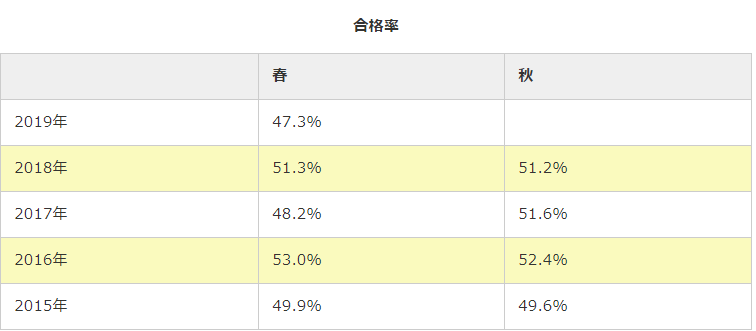
These are the pass rates for the last 5 years, as you can see roughly 50% of the candidates pass.

Final Thoughts

Having almost completed the level 1 exam, I must say that it is not impossible to pass. This is especially true as unlike the CFA, you have a big advantage that you can take the exams individually. You also have specific types of questions that reoccur, so practising as many questions as possible helps. A Japanese candidate would tend to spend 1-6 months preparing for the exam depending on their background. I think the average (non-Japanese?) candidate working in the financial sector should need 3-4 months to be comfortable in his/her preparation. If you are considering taking the exam and have any questions please do not hesitate to contact me!

Some jargon that you might find useful in preparing for the CAIA exam

The CAIA exam focuses on alternative investments and if you are new to the industry or to the subject, you might come across quite a lot of new terms. I have compiled a list of some terms that you might find useful in your studies.

2/20 (two and twenty): this refers to the fee structure that is charged by hedge funds. The 2 refers to the recurring 2% management fixed fee that is charged as a % of assets held. The 20 instead refers to the 20% fee that is charged on any investment returns.

Accredited Investor: accredited investors are individuals who are allowed to invest in sophisticated investments such as hedge funds, VCs, private placements, etc. In order to be classed as such, accredited investors need to meet a number of criteria such as having a net worth of $1,000,000 or having an income of at least $200,000 (these criteria might vary based on the country).

High-Watermark: this is the highest fund value reached by a fund. High-Watermarks are very important when we are talking about performance returns that are paid out to hedge fund managers. Let’s look at the below example:

Assuming a fund’s NAV (Net Asset Value) at inception in 2014 is 100 we can see that in 2015 it had a return of 20% and the NAV grew to 120. The fund will take 20% of the 20 that it made in profit (Year 2 NAV – Year 1 NAV which is equal to 120 – 100 = 20 from the table above). Therefore 120 is the High-Watermark at this stage.

Similarly, in the following year it rose again by 20 and now the returns are calculated in terms of any gains made above the High-Watermark of 120 so (140-120)*20%, the new High-Watermark now becomes 140.

In the following year we can see that the fund didn’t have such a great year and it’s NAV fell to 120. No performance fees will be paid as the NAV value was below the High-Watermark. If we look at the next year we can see that the fund posted some gains from 120 to 130 but still this is below the 140 High-Watermark so no performance fees arise.

CTA: stands for commodity trading advisor. This is a term used to define a hedge fund that aims to generate returns via futures, options and forex trading.

Vintage: vintage refers to the year when the VC fund was set up. When you are comparing returns of VC funds, it’s very important to compare two funds that have the same vintage. Fund performance will be hugely affected by the prevailing economic conditions from when the fund was set; comparing two funds with the same vintage allows us to make a fair comparison.

General Partners vs. Limited Partners: you will come across these terms when looking at private equity. The general partner will be involved in the day to day running of the VC firm where he or she will manage the projects and decide which projects to invest in. Limited partners on the other hand are not involved in running the VC firm but instead they provide the funds that the General Partners put to use to increase the value of the firm.

Cap Rate (Capitalization Rate): you will come across this term in real estate and you can interpret it as the yield that your property is offering. The Cap Rate is obtained by Net Operating Income (NOI)/Property Value.

REIT: stands for Real Estate Investment Trust. A REIT is a company that owns and operates a real estate portfolio. Real estate could range from warehouses, hospitals, commercial properties, residential properties and more. REITs are listed on exchanges and investors can buy REITs just like ordinary common stocks. REITs tend to have inflows of cash flows in terms of rent paid by tenants and this allows for such returns to be paid out to investors in the form of hefty dividends which could range from 2-6%. They could be a good for income generation and moderate inflation protection. REITs are sensitive to economic conditions and fluctuations in the property market.

I just sat my June 2019 CFA exam, what next?

This weekend saw a record number of 250,000 CFA candidates sitting the exam around the world. This is a whopping 11% increase compared to the previous year. If you are one of those candidates who just sat their CFA exam, I am sure a lot will be going through your head at the moment. After hours spent reading through study notes and solving questions, today was the big day and whilst you eagerly wait for your results I am sure that you cannot help but ask yourself one crucial question – have I passed?

Post exam I think candidates can be divided into three distinct categories. The first ones are those who think they absolutely nailed it. To these candidates if their confidence is legitimate and it was a genuinely good exam, I would like to congratulate them for their success without jinxing them. The ones in the second category are ones who just walked out of a dreadful exam and are fairly confident that they will be resitting in the following year and to these candidates my message is “don’t give up, learn from today’s mistakes and keep trying, perseverance will pay off in the future”. The last category which I was always part of and I think most candidates come under, are the ones who are somewhere in between the pass and fail mark. This post is mainly aimed at them.

At this stage, people in this category will be debating whether they should start revising for the next level (if they are level 1or 2 candidates) or keep studying for the exam that they just took. My advice for those people is to leave your books on the side and unplug yourself from the CFA exam for the next couple of months. For level 1 and level 2 you will get your exam results on 6th August, for level 3 instead you will have to wait until 20th August. If you really cannot resist the urge to study for the CFA exam, I recommend some light reading but don’t try to keep your pre-exam study schedule otherwise you will risk burning out before your next exam. When I was studying for the CFA exam myself, I kept getting told that exam preparation is like a marathon. I observed that candidates who revise at a steady pace and are able to maintain a healthy balance between their studies and a life outside their studies are the ones who are most likely to succeed. You should wait for your exam results to have all the required information to formulate your next study plan. If you did put in all the hours of preparation but cannot help thinking about how difficult today’s exam was, chances are other candidates found it hard as well. Remember the averaging passing score that CFAI sets is based on the difficulty of the exam; if you think you answered relatively well on a pretty tough exam I’d say that your chances of passing are good. If instead you dropped careless points on a relatively easy exam, chances are that other candidates will have done better, putting you below the average passing score.

Regardless of today’s outcome my final words of advice are to take a step back and to appreciate the journey rather than the result. Think of how much more knowledgable you are in the field of investment management and think of the people you met throughout your studies. Your future should not be defined by the outcome of this single exam, rather it will be defined by how you react when you are faced with tough challenges and occasional failures. Don’t give up and keep persevering in your journey.

CFA Level 3 General Overview and Tips

So you’ve reached the final CFA exam. This is not something to be sniffed at so you should be proud of your achievements. You are almost there and I am hoping that this article will help you in your studies and will guide you towards the right direction, so please keep reading.

IPS is King

If you have done some research on the exam format or you have attempted past questions, I am sure that you have noticed that for the first time you are not faced with multiple choice questions and instead you will have what they call ‘constructed responses’. Yes, you will have to write sentences using pencil and paper rather than marking an answer sheet. An IPS which stands for Individual Policy Statement is a type of constructed response question that you will see in the morning session, needless to say you need to be scoring high on IPSs if you want to pass. Please note that the afternoon format is multiple choice.

If I was explaining what an IPS is to my grandmother, I would tell her that it’s an assessment of her current finances and set of financial goals. You need to picture yourself as a financial advisor, helping your client come to grips with his or her financial situation; this entails being aware of any assets that are held, sources of income or any expenses. Given your client’s financial situation you need to assess the below points:

 Time horizon: what is your client’s time horizon? 10, 15 years? If we talk about inheritance this could extend to a longer period. Multi-generational time horizon is a buzz word you might want to take note of.  

·Taxes: should there be any aspect that would cause a high tax expense, note this down and remember to emphasise tax efficient investing.

·Liquidity: liquidity is very important. After having assessed your client’s outflows, is their source of income sufficient enough to cover them? If there are a lot of foreseeable expenses and your client’s wealth is concentrated in illiquid real estate then liquidity could be a problem.

·Legal: you don’t tend to see this come up but always acknowledge that local laws apply and should there be applicable laws from multiple jurisdictions, mention that.

·Unique: you will easily notice this. This tends to be some unique situation that your client is in. For example, the majority of their wealth might come from their company or it could be their aversion towards sin stocks.Then you will need to assess your client’s ability and willingness to take risk. Willingness is more related to cognitive aspects, so make sure to pay attention to any traits or biases that the person could exhibit. Ability is more of an objective assessment. Does your client have a sufficiently large portfolio and a long-term time horizon? Then chances are he/she will be able to afford having a more aggressive portfolio to aim for higher returns in the long run. If instead your client is retired and their portfolio is their only source of income and they have numerous upcoming expenses, then chances are high that you should be conservative. You should recommend your client to invest in safe instruments that provide a steady, reliable stream of income. 

OK so how do I nail an IPS question you might ask?

(1) Write concise and clear bullet points. When I was first tackling the questions I was making the mistake of writing long, convoluted sentences making it hard for the marker. The marker will have an answer key and will be ticking boxes to ensure that you covered the relevant points.

(2) Practise, practise, practise. You just need to get used to answering IPSs. A good thing about CFA Level 3 (unlike levels 1 and 2) you will have access to past morning exam papers, so make sure to attempt them and see what recommended responses the CFA Institute provides. When doing past papers though, be careful NOT to go too far back into the past as some of the questions will not be as relevant.

(3) If you have a study partner, try to mark each other’s papers. It might be helpful to have another person read your responses and give you some honest feedback as to whether you covered the main points. Sometimes when marking our own mocks we might give ourselves the benefit of the doubt whilst examiners might not.

(4) Passion. OK you might think that this might sound strange but try and think of yourself as a consultant or a financial advisor. Try and think of the people who pop-up in the question as if they were real clients, friends or family. After months or years of gruelling studies, you are the financial expert – what genuine advice would you give them so that they can reach their financial goals? I found approaching questions in this manner to be entertaining and helped concepts to stick in my mind.

Is CFA Level 2 harder than CFA Level 3?

This is a debate that I find very interesting. Some people pass level 2 and will tell you that you have cleared the hardest exam, others will tell you that level 3 is a real nightmare. I personally think that if you are the technical and mechanical type, you will find level 2 a fair exam. You should not approach level 3 with the same mind-set that you had for level 2, I certainly did and got punished for it. This might sound abstract but for level 3 you need to see the big picture. Level 3 isn’t about how quickly you can value swaps or calculate free cash flows, it’s about being able to understand your client’s situation and applying sound judgement in addition to technical knowledge. Level 3 takes for granted that you have understood the core concepts and requires you to put them into practise in the field of portfolio management. For this reason if you have started preparing for level 3, I would personally recommend just skimming through the whole curriculum and getting a general idea, then going into the nitty gritty details.