My thoughts regarding the CAIA Exam

So, you are interested in alternative investments and you are seriously considering taking the CAIA exam?  I passed the level 1 and level 2 exams a few years ago and I would like to provide you with some genuine pieces of advice that I hope you will find useful.

For those who have not come across this qualification, CAIA stands for Chartered Alternative Investment Analyst and the whole exam goes into a lot of depth in testing candidates about alternative investments. If you are interested in learning about common hedge fund strategies, going deeper into commodities and real assets, I think you will enjoy studying for the exam. I certainly did.

What is tested and how are topics weighted?

CAIA Level 1 Topics Exam weight
Professional Standards and Ethics 15% – 20%
Introduction to Alternative Investments 20% – 25%
Real Assets (Including Commodities) 10% – 20%
Hedge Funds 10% – 20%
Private Equity 5% – 10%
Structured Products 10% – 15%
Risk Management and Portfolio Management 5% – 10%

Exam Format

If you want to become a CAIA Charterholder you will have to complete two exams in addition to meeting other requirements, such as four years of work experience or a bachelor’s degree with one year of work experience. For level 1 you will have 4 hours to complete 200 multiple choice questions (you can choose to take a 30 minute break which I strongly recommend you do). You will also have a total of 4 hours for level 2, however this time in addition to 100 multiple choice questions you will have a section on constructed responses. A plus if you have already completed the CFA exam is that the ethics portion tests you on the CFA Standards of Conduct, so for this section you have killed two birds with one stone.

Unlike the CFA exam, the CAIA exam is computer based; so if you are like me and you enjoy marking answer sheets with your HP pencil you will be disappointed. You will be spending hours staring in front of a computer screen so if you decide to take the exam make sure to take online mock exams so you get used to starting at a screen for a long period of time.

Exam Windows

An advantage of the exam being computer based is that there is some flexibility with regards to the dates on which you can sit the test. The exam windows for 2019 are:

  • Level 1: September 2 – 13
  • Level 2: September 16-27

How to prepare for the exam?

The CAIA institute provides core textbooks for each level (materials can be found here). The Chapter Head for CAIA is Keith Black and his research is very well respected in the field.

It goes without saying that there are a few training providers out there who sell their study notes. I have had a look at the Schweser ones and similarly to the CFA study notes they are well written and the information is summarised well. However, in my case, going through the curriculum and doing a few mocks was more than enough.

Overall I’d say that if you have some foundations in finance, 100 – 200 hours for level 1 and 200 to 250 hours for level 2, this should allow you to pass the exam. Don’t be fooled by the pass rates, it’s definitely not an exam that you want to underestimate, especially level 2.

How to tackle item sets in level 2

If you have been used to answering multiple choice questions, the idea of typing your responses for item set questions might be intimidating. From my experience the markers will mainly focus on content and you shouldn’t get marked down for your style although clear and well structured responses will be appreciated. My advice is to provide short clear and concise bullet point answers.

General thoughts regarding the exam

Ok, if you have read this far you might be asking yourself if overall the exam is worth taking. The short answer in my opinion is “Yes” but again this will depend on your situation and your career goals. If you think this qualification will help you get hired straight away in a VC fund then you will need to reassess your expectations. The alternative investments industry is extremely competitive and you will need more than a qualification to differentiate yourself from the competition. I think the exam has the following two benefits:

  • The curriculum is very well structured and provides a good overview of alternative investments. Upon completing it I felt like I knew a bit of everything regarding alternative investments; as a professional working in the financial sector it definitely helps having awareness of a wide range of asset classes.
  • The network. I attended several events and I have had the pleasure of meeting William (Bill) J. Kelly, CEO of the CAIA Association. I had a very positive experience talking to him and I could feel his drive and passion in expanding this association globally. The events that I attended were in Tokyo and although the society is still relatively small compared to other capital cities, I am confident that it will keep growing in popularity. A lot of the charterholders here in Japan are quite senior people who have pursued the exam with the sole purpose of expanding their knowledge, so if learning is a key priority in life you will meet a lot of like minded people.

In future posts I intend to cover some topics that I especially enjoyed studying when prepping for the exams, so hopefully you will be able to use the content for your preparation. Thanks for reading and good luck with your studies.

 

CFA Level 2 General Overview and Tips

If you are reading this post, chances are you’ve passed the Level 1 exam. If that’s the case, congratulations, that’s a great achievement! Give yourself a pat on the back before you start worrying about how to tackle level 2.

In the Level 2 exam you are tested in the form of 20 case studies or item sets (10 in the morning and 10 in the afternoon). Each item set has 6 questions so that’s a total of 120 questions in 6 hours. The topic weights can be found here.

Compared to the level 1 exam, level 2 goes into much more detail in terms of testing concepts. If the theme of the questions in level 1 were “Do you know it?” level 2 instead asks “Can you apply it?”. A lot of candidates end up failing this exam as they find the number of formulas overwhelming and intimidating. In this post I have summarised some advice that I received when preparing for the exam, advice that I hope helps you pass the exam.

(1) Don’t try to memorise the formulas but try to see the big picture.

I’ve seen so many candidates trying to just blindly memorise and apply formulas, losing sight of the big picture. This is dangerous in my opinion. If you are the type who does well in memorising and applying formulas, then I’m not here to dispute your exam technique. If you have tried doing a few mocks and have been constantly scoring +60% then by all means please stick to your way. What I am trying to say is that from my experience, I struggled when I attempted to memorise all the formulas and when I applied a more intuitive approach in solving questions that worked for me. This might sound a bit abstract so let me give you an example.

Let’s say you are looking at Economics where you might be asked to adjust the exchange rate using PPP (Purchasing Power Parity). In our example we will use Japan and the US, the exchange rate is USD/JPY = 110 JPY and the inflation rate in the respective countries is 1% and 2%. The essence of PPP is that whether you buy goods in Japan or the US it shouldn’t make a difference.  If goods are becoming more expensive in the US compared to Japan, i.e. higher inflation, this will be reflected in the expected exchange rate where Japan is the domestic currency and the inflation is for a 1 year horizon.

E ( S ) = S _ { 0 } \times \frac { \left( 1 + i _ { f } \right) ^ { n } } { \left( 1 + i _ { d } \right) ^ { n } } = 110 \times \frac { ( 1 + 0.01 ) ^ { 1 } } { ( 1 + 0.02 ) ^ { 1 } } \cong 108.92

OK, you might ask what’s so hard about applying such a seemingly innocent formula. To start with, I have seen a lot of candidates spending a lot of time in trying to figure out how the exchange rate is quoted, which currency is domestic and which one is foreign (others used quoted and base); add the pressure under exam conditions and you are prone to make mistakes. The way I used to approach this question was to tell myself: OK, inflation rates are higher in the US and that means that their currency will have to weaken against the Yen. I would apply the formula and check my result. I can see that indeed 108.92 < 110. At first 1 USD could get you 110 JPY, now it can get you only 108.92 JPY. Indeed the Yen has strengthened (or the Dollar has weakened). Should I have accidentally flipped the numerator and the denominator, this check would have allowed me to detect my mistake. This was just a simple example but this way of thinking can be applied to many other questions on the CFA exam. There are a lot of red herrings on the exams so being able to spot and avoid them is a key factor in your exam success.

(2) Tips for Level 1 are still valid.

What I covered in my CFA level 1 post is also applicable to Level 2. Pay attention to the exam weightings in your preparation to ensure that you are scoring well in heavy topics like accounting and equity. Decide whether you want to pay a training provider or whether you have the time and discipline to self-study; this is definitely something you want to consider if your job is taking up a lot of revision time. The competition in Level 2 is fierce and chances are slim that you will pass with just 1-2 months of cramming.  This is an exam where candidates who put in 200+ hours of studying end up failing.   

(3) Don’t read the whole item set before attempting the questions

When I first started tackling exam questions I used to read the whole case study before moving on to the questions. My mind was bombarded with information and the questions were very detailed so I found myself going back to the item set and looking for key piece of information, then going back to the questions, going back and forth. Needless to say, I was struggling with time. It was only throughout my revision that I realised the obvious; item sets are very often divided into paragraphs and there tends to be a one to one map between paragraphs and corresponding questions. Just to be clear, if there are 3 paragraphs and 3 questions, paragraph 1 will have the information that you need for question 1, paragraph 2 will have the information for question 2 and so on. My advice is to first read the questions and then start reading the item set; when you are reading the item set, if you think you have identified some information that will help you solve any of the questions, then solve the questions before moving on. This approach also helped me from a mental perspective as when I was done reading the item set I wouldn’t be going back to 6 blank questions.

(4) Find a topic where you can differentiate yourself from other candidates

In order to pass the CFA exam you will need to achieve what they call a minimum passing score; the CFA institute uses the Angoff Standard Setting Method in determining this. If you are getting the bulk of your points from easy questions, chances are that other people sitting the exam will be getting those as well. If overall the exam was an easy exam the pass rate will be set higher and therefore even if you do average or just slightly below average, chances are that you will fail the exam. You obviously need to get points in the easy questions but you also need to score in questions where other candidates struggle to get an edge over them. In my case, for level 2, derivatives was the area that helped me. A lot of candidates around me had given up hope on derivatives as they found a lot of the questions challenging. I persevered and I was rewarded on exam day.  

I hope you found this advice useful and don’t forget to leave your comments. Good luck with your preparation and with your CFA journey!

Furusato Nozei (Hometown Tax Donation Programme) in Japan

If you live and work in Japan, you should definitely be taking advantage of this benefit. Furusato Nozei or Hometown Tax Donation Programme is a system that was introduced by the Japanese government in 2008 to bring back and to promote business in local prefectures. The way it works is that you pick a prefecture or municipality that you want to donate to and in exchange for your donation you will get local produce sent to you. OK, so what’s in it for me you might be asking? The short answer is that you will be entitled to a tax credit equivalent to the donation amount (minus a 2000 JPY portion which is not tax deductible), so with only 2000 JPY you are technically getting goods of superior value for free. Not bad.

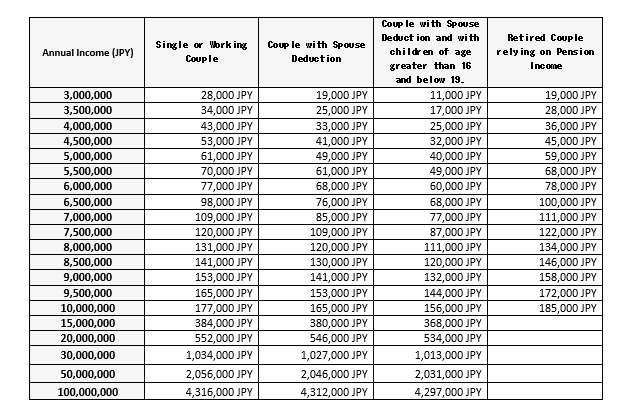
The amount that you can donate will depend on your tax bracket and on other tax credits that you might already be claiming. The below are very rough estimates but they should give you an idea of how much you can expect to claim based on your income tax bracket.

(SOURCE: https://www.furusato-tax.jp/about/simulation#simulation-detail-link-pc)

There are several websites that offer online simulators to help you calculate the exact amount that you can donate. Here are a few that I recommend:

Good Simulator in English

https://en.furumaru.jp/info/simulation.php

Detailed Simulator in Japanese

https://www.furusato-tax.jp/about/simulation#simulation-detail-link-pc

How does it work?

Assuming you went through the above simulators and you have the amount that you want to donate, you can check online shops that allow you to order Nozei Gifts. The below are just some examples that I’ve picked:

  • A website in Japanese that provides a ranking of popular Nozei Gifts.

https://furunavi.jp/ranking_total.aspx

  • This is the one that I have been using. Unfortunately, it’s only in Japanese but it provides a good selection of products and a user-friendly interface.

https://www.furusato-tax.jp/

These are just a few examples but you can type Furusato Nozei in to any search engine and you will come across numerous results.  You will be able to order a wide selection of items:

  • Fruit and vegetables from local prefectures
  • Holidays to visit your chosen prefecture
  • Alcohol
  • Clothes
  • Pottery
  • Sweets

And the list goes on. 

Don’t forget to pay by credit card for that extra bit of value.

I have a Rakuten credit that gives me 1 point for every 100 JPY spend. So if I donate 100,000, that’s 100,000 * 0.01 = 1,000 JPY which is nothing to be sniffed at, plus my yearly Furusato Nozei spend helps me maintain Platinum status on my card which comes with added bonuses.

Will I need to file a Tax Return (確定申告)?

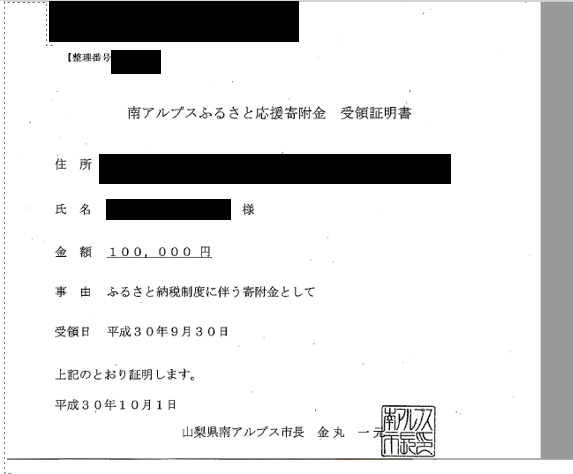
You can use the “One Stop Special Exemption” instead of filing a Tax Return. When you pay for your gift the prefecture will send you a thank you letter via post in addition to proof of your donation. Ensure to keep this in a safe place as it might be required in the future. In addition to this, you will also receive a form that will allow you to request the “One Stop Special Exemption”. Basically, if you tick yes to this and send the relevant documents, the prefecture will automatically declare your donation to your local tax authority so you don’t need to declare it yourself. The relevant documents are: (1) a scan of your My Number Card/Notification Card (2) a scan of an authorised document (passport, resident card, insurance card etc.), you will see in your form what documents are allowed so make sure to read that to avoid having to send documents back and forth. To note that if you have to file a Tax Return for other purposes (which was my case), you WILL need to declare your gift in order to get your tax deduction. This is when your proof of donation document is required. If you declare your donation in your Tax Return you will need to post the original certificate of receipt for your donation (make sure to take a scan before sending the original). I have scanned below the receipt that I got so you can see what one looks like:

Now that you have done the hard work, the next step is to enjoy the gifts that you will receive via post. As for the tax deduction, you will reap the rewards in the form of a tax deduction from the income tax and resident tax in the following fiscal year.

I hope you find this post useful and if you have any questions please feel free to post them in the comments section. Thank you for reading.

Top 5 Popular Stocks in Japan that Offer Yutai Gifts

Yutai Gifts 株主優待 (Kabunushi Yutai) are perks that companies give to their shareholders as a form of gratitude for owning their stocks. These gifts are often tied to the product or service that the company provides. A lot of retail investors find Yutai investing appealing and there are numerous websites in Japanese that summarise and rank these Yutai offerings. I have done my own bit of research and I have come across quite a few companies that provide competitive rewards. Over the months I have created my own list of popular Yutai stocks that I would like to share with you.  

How do I receive my Yutai Gift? 

Before we get started with our top 5 list, you might be asking what is required to be eligible to receive these gifts. 

  • You will need a brokerage account in order to purchase the stocks. For guidance in opening up a brokerage account in Japan, please refer to this article
  • Purchase the stock and hold it until the relevant ex-right date (the date on which you are eligible for the gift if you are the shareholder).
  • You will receive your Yutai Gift via post (most companies have a detailed description on their website regarding the Yutai Gift timings so you will be able to check online the exact dates of when you can expect to receive your rewards.

Now, let’s get started. All share prices are based on closing prices of 16th May 2019.

(5) Skylark Holdings (3197)

skylark

Company Profile: Skylark Group runs numerous family restaurant chains in Japan. Gusto and Jonathan’s were the two restaurants that I was aware of but their brand portfolio seems quite extensive and includes a wide range of cuisines. You can find a list here.

Gift: Coupons that can be used across their restaurants. Every 6 months you will receive 3,000 JPY worth of coupons so that’s 6,000 JPY per year just in coupons which isn’t that bad (these coupons are relatively easy to sell online or at ticket shops like Daikokuya.

Minimum Shares Required: 100 shares

Investment Amount: 100 * 1868 = 186,800

(4) Japan McDonald’s Holdings (2702)

mcdonalds

Company Profile: McDonald’s needs no introduction; their burgers are widely consumed around the world and Japan is no exception. 

Gift: You get the below booklet which has 6 sheets. Each sheet has 3 coupons which can be exchanged for 1 burger, 1 side and 1 drink or dessert of your choice. I have seen people assigning different values to this coupon. Some people came up with their valuations by picking the most expensive items on the menu that they can order, which brings the monetary value of a booklet close to 7000 – 8000 JPY. I have seen more fair estimates which value this coupon at around 5000 JPY.

mcdonaldscoupons

Minimum Shares Required: 100 shares

Investment Amount: 4880 * 100 = 480,000 JPY

(3) ANA Holdings (9202) / JAL (9201) ( (I put both airline companies together as what they have to offer is pretty similar in my opinion).

jal

Ana

Company Profile: JAL and ANA are the two biggest domestic airlines in Japan and are with well established internationally.

Gift: 50% off domestic flights. Considering domestic flights can range from 20,000-50,000 JPY, you are looking to save 10,000 – 25,000 JPY on your travel fare. Similarly to other Yutai Gift tickets you will be able to easily sell them online. 

Minimum Shares Required: 100 shares (to note that the number of free tickets increases as the number of shares increase). For JAL this website (in Japanese) has a good summary of the benefits, there are also added bonuses such as additional coupons for holding the stock for 3 consecutive years.  

Investment Amount: ANA (3,750 * 100 = 375,000 JPY) JAL (3,607 * 100 = 360,700 JPY)

(2) Oriental Land Co. Ltd (4661) 

olc

Company Profile: Headquartered in Urayasu, Oriental Land runs Disney Land and DisneySea, two very popular theme parks in Chiba. In addition to its theme park business, the company also manages a number of hotels including the Disney Ambassador Hotel.

Gift:  1 free entry pass for either Disney Land or DisneySea (entry price for adults is 7,400 JPY). If you are a fan of Disney and their theme parks I could definitely see the appeal for this gift. Alternatively the coupon can also be easily sold online as there is huge demand for it. 

Minimum Shares Required: 100 shares

Investment Amount: (12,935 * 100 = 1,293,500 JPY)

(1) Aeon (8267)

Aeon

Company Profile: Aeon runs a large chain of supermarkets across Japan and Asia. If you hold their shares you will be sent their “Owner’s Card”. This will entitle you to claiming 3% cash back on your purchases made in cash or via Aeon credit cards (please note that purchases made with non-approved credit cards will not be counted) at their stores. If you regularly do your shopping at Aeon the cash back becomes quite appealing. Similarly to other Yutai gifts, you will entitled to cash back every 6 months. For example, let’s say that over the past 6 months you spent 500,000 JPY at Aeon, your cash back amount will be 500,000 * 0.03 = 15,000 JPY.  Considering the stock trades at around 2000 JPY, that’s 15,000/200,000 = 7.5% yield and we are not even including dividends.

Gift: 3% cashback card.

Minimum Shares Required: 100

Investment Amount: 1989 * 100 = 198,900 JPY

What are your top picks? Have you come across any good stocks with Yutai gifts? Please post your top picks in the comment section. Thank you for reading.

The Time Value of Money

The Time Value of Money is a core concept in finance. If you are in the early stages of your studies in the field of finance then this is a concept that you want to ensure that you understand well. In your Finance 101 class your professor might have asked you, “Would you prefer $1.00 today or would you prefer a dollar tomorrow?”. This is when students shout out “A $1.00 today is more valuable assuming no negative rates”.

They would be absolutely correct as a dollar today could be immediately deposited in a bank account to earn interest. Just to avoid adding unnecessary complications we are assuming that any payments in the future are guaranteed so there is no element of uncertainty in the expected payment; both payments are guaranteed so the only differentiator here between a dollar today and a dollar tomorrow is the opportunity cost of losing out in interest payments. So, when you are presented with this question, remember to think of what you could be doing with the money in hand. Interest earned from a bank account was just an example but what if you have a valuable project that you could invest in today to double your cash?

The Relationship Between Future Value and Present Value

So how about $0.97 today or a $1.00 in a year, which would you prefer? Now the answer to this question isn’t as obvious. We first need to make a very important remark as $0.97 and $1.00 are not two quantities that we can compare. We need to compare apples to apples. We can do this in two ways: (1) find what $0.97 would be in terms of Future Value or (2) We can find out how much $1.00 is expressed in Present Value terms. The second method is more common, especially if we think of projects which require immediate cash outlays. I call the option of getting $0.97 today Option A and the option of getting $1.00 in a year Option B.

Assuming you get 3% interest rate for depositing your cash in a bank account, you can calculate how much you would end up with in a year’s time.

FV = Deposit + Interest or 0.97 + (0.97 * 0.03) = 0.9991

A more generic way of calculating future value is:

FV = (1+r)^n * PV

where, r is the interest rate and n is the compounding frequency, in this case 1 year so n = 1. Via the above formula you can calculate the Present Value of your $1 in a year’s time.

FV = PV/(1+r)^n

therefore, 1.00/(1+0.03)^1 = 0.97087

Now we can compare like for like, for Present Value we can summarise our findings in the below table:

Present ValueFuture Value
Option A0.970.9991
Option B0.970871

We can see that both in Present Value Terms and Future Value Terms Option B, or getting $1.00 in a year, results in us being better off.

Time Value of Money is a very powerful concept that comes up everywhere in finance. Whether it is in the form of evaluating companies and projects or finding the fair value of a complex derivative trade, we must always take into account the Time Value of Money in our models.

The Dividend Discount Model

The Dividend Discount Model, also known as the Gordon Growth Model is a formula that allows us to calculate the intrinsic value of a stock. The model assumes that the fair value of a stock is the present value of all future dividends that the company pays to its shareholders. These dividends are discounted to present value by using the required rate of return for the stock.

We firstly assume a model where the dividend amounts are fixed.


  S_{0} = \sum_{t=1}^{n}\frac{ D_{t} }{ (1+r)^t }

As    n \to \infty

we obtain  {S_{0}=\frac{D_{t}}{r}}

This result is what we call a perpetuity (an annuity that pays fixed cash flows at constant intervals until infinity). The model assumes that all company dividends are paid out therefore there is no growth in the company’s dividends. Very rarely, companies pay out all their earnings in dividends, instead a proportion of earnings are retained internally to help grow the company in the future. By adding this assumption we introduce the company’s “sustainable growth rate”. This is the constant rate at which we assume that the company and therefore the dividends will grow in the future.

 S_{0}  = \sum_{t=1}^{n} \frac{ D_{t}(1+g)}{(1+r)^t}

As    n \to \infty

We obtain (a growing perpetuity):


 S_{0}=\frac{D_{t}}{r-g}

Limitations

  • The model isn’t applicable to companies that currently do not pay dividends.
  • Dividend amounts may fluctuate over the course of the years, so it might not make sense to assume that they are constant. In such cases we need to look at more complicated models like a two-stage dividend growth model.
  • The model requires precise estimation as the stock price is very sensitive to the assumptions that we place for the growth rate (g) and the required rate of return (r).

Advantages

  • Well known and relatively simple to use.
  • Applicable to well established companies that have a long track record of paying out dividends.

Worked Examples

Question 1

Company A pays $80 in dividends and is expected to pay the same dividend amount forever. Investors require a 10% rate of return for this stock. What is the intrinsic value of the stock?

‘Answer: 80/0.10 = $800

Question 2

Company B pays $25 in dividends and is expected to pay the same dividend amount forever. Investors require a 5% rate of return for this stock. What is the intrinsic value of the stock?

‘Answer: 25/0.05 = $500

Question 3

Company C is expected to pay a dividend of $35 next year. The company’s sustainable growth rate is 5% this growth rate is expected to be constant. Investors require a 7% rate of return for this stock. What is the intrinsic value of the stock?

‘Answer: 35/(0.07-0.05) = $1750

Question 4

Company C is expected to pay a dividend of $2 next year. The company’s sustainable growth rate is 2% this growth rate is expected to be constant. Investors require a 12% rate of return for this stock. What is the intrinsic value of the stock?

‘Answer: 2/(0.12-0.02) = $20

Feel free to post any questions you may have. Happy Studying!

What Is Duration and Why Does it Matter?

Throughout your studies of fixed income, very often you will have come across the concept of Duration. So why is it so important? Duration measures the sensitivity of your bond to changes in interest rate. Let’s say interest rates drop 1%, by using duration you can get a rough approximation of how much your bond price changes.

Bond Price and Interest Rates

Before we get started with Duration, let’s talk about bond prices and interest rates. You might have heard the expression that bond prices and interest rates are negatively related. Interest rates go down and your bond price rises, interest rates rise and your bond price drops. This is because the value of your bond is the summation of the present value of all future cash flows, so the higher your discount rate (interest rate) the lower the price of your bond.

Let’s assume that we have a bond that pays a 5% yearly coupon with a face value of 100, prevailing yields are 6% across all tenures. For simplicity, I am assuming that we have a flat yield curve with interest rates constant across all tenures.

Assumptions
Coupon 0.05
Face Value 100
Yield 0.06
  Years CFs CFs PV
Year 1 1 5 4.7170
Year 2 2 5 4.4500
Year 3 3 5 4.1981
Year 4 4 5 3.9605
Year 5 5 105 78.4621
Bond Price 95.78764

As the the coupon rate of 5% is lower than the prevailing 6% rates, the bond is trading under par. Given the above assumptions we will calculate two key duration measures, the Macaulay Duration and the Modified Duration.

The formula for Macaulay Duration is as follows:

 D_{mac} = \frac { \sum _ { i = 1 } ^ { N } \frac { t C _ { ( i ) } } { \left( 1 + r _ { i } \right) ^ { t } } } { P _ { 0 } } = \sum _ { t = 1 } ^ { N } t W _ { ( t ) }

Where  P _ { 0 } is the price of the bond,  r _ { i } is the yield to maturity and t is the year. Applying the formula in our example we get that the Macaulay Duration is 4.53 years. We can interpret this figure as the average number of years that it would take for the bond to repay the initial investment.
The formula for the Modified Duration is as follows:


 D_{mod} = \frac { D_{mac} } { \left( 1 + \frac { \mathrm { r_{i} } } { \mathrm { n } } \right) }

Applying the formula we obtain 4.32 for the Modified Duration.

Now that we have the Modified Duration for this bond we can evaluate its sensitivity to changes in interest rates. The expected change in the bond price can be approximated by Modified Duration * Change in Rate * Bond Price. Looking at our example, if we assume that interest rates drop from 6% to 4%, then -4.32 * -0.02 * 95.79 = 8.27 is our estimated change in bond price and in reality we saw that the bond did rise by 8.66 so we can see that our approximation was quite accurate.

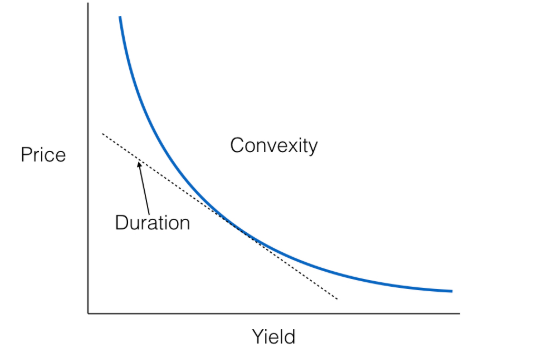
Duration however is only accurate for small changes in interest rates as it is only a linear approximation; we can see from the below graph that the relationship between interest rates and price is convex.

If Duration is the first order derivative between price and interest rates, we can better approximate the actual change in price by adding a second order term in the form of Convexity. I will be covering this in future posts in addition to other Duration measures such as Key Rate Duration and Effective Duration.

CFA Level 1 General Overview and Tips

So, you are seriously considering taking the CFA exam and you might be looking for some information online, if so, congratulations you have come to the right place. I sat and passed the exam back in 2011 and I would be happy to share my advice here. Luckily, not much has changed since then with regards to the test format and the content so I believe that what I cover in this post is still valid for candidates preparing for the exam today.

Topics Covered

The CFA Institute provides here a detailed overview of topics which are covered in each level. Not all topics are weighted equally so successful candidates are good at identifying core topics and questions and are able to focus on these areas in their preparation. The learning focus according to the CFA Institute is “Knowledge and Comprehension” rather than “Application and Analysis” which will be tested in Level 2. In my opinion, Level 1 is all about the candidate gaining a general knowledge of all topics whilst grasping the foundation of investment analysis concepts which he/she will use later on in performing investment analysis.


weights

Exam Format and Exam Strategy

The exam consists of a morning and afternoon part, each containing 120 multiple choice questions (to note that there is no negative marking so do not leave any questions blank). You will have 3 hours to complete the questions so you will be under a lot of time pressure. It’s important to avoid spending too much time on any single question so if you are not sure about a question, mark it and come back to it later. Aim not to spend more than 90 seconds on a single question, there won’t be long calculations involved so if you have a good mastery of the topic you should be able to come up with an answer relatively quickly. When I took the exam I aimed to finish the exam in an hour so I had the last 20-30 minutes to review my answers. As you take mock exams  you will develop your own test taking technique but the key point that I want to get across is that pacing yourself is as important as your knowledge of the curriculum.

Study Resources

The moment you register for the CFA Institute you will get access to the Institute Curriculum which will be shared to you as an E-Book. I also recommend ordering the hard copies of the Institute books which will be sent to you via post. The whole curriculum consists of 6 thick volumes that will take a lot of space up and will be a perfect substitute-friend for the upcoming 6 months or so. The question that a lot of candidates ask themselves now is whether the Institute materials are enough or if they require some additional source of help in the form of study notes or video lectures. Schweser is a very popular choice amongst candidates. Others might also opt to take classes via other training providers. So, are training providers worth the additional cost? It really depends on the candidate’s background and circumstances in my opinion. If a person already has a good finance background and has time to commit in reading the curriculum I don’t think he/she needs to rely on training providers. If instead time is a constraint or finance is a new subject then possibly the additional help will provide to be valuable and worth it. Overall I think training providers have done a very good job in analysing the exam, identifying the key topics and ensuring that their students have a high chance of passing. My experience with them has been positive.

The Calculator is your Friend

There are only two types of calculators that you will be able to take into the exam with you – read the official Calculator Policy here – Texas Instruments BA II Plus and Hewlett Packard 12C. If you have registered for the exam and you are in the early stages of your preparation my advice is to start getting familiar with the calculator as soon as possible. There are a lot of questions on the exam where you will need it and you will be able to quickly score valuable points. Some examples of where your calculator will come in handy are: Present Value/Future Value, Bond Calculations, NPVs (maybe some Statistics functions and Annuity calculations).

calculator

Last Words of Advice

  • Remember to do the end of chapter questions in the official CFA books. All questions are of high quality and are very likely to be tested on exam day.
  • Do not have a heavy lunch in between the morning and afternoon exam.
  • Remember your exam ticket and passport on exam day otherwise you will not be able to sit the exam that day.
  • Think of your study as a marathon not as a sprint, towards the final week of the exam do some light revision and preserve your energies for exam day.
  • Get yourself a nice study group to have people who you can share your joys and pain with.

Thank you for reading and I hope you look forward to future posts.

Opening a Brokerage Account in Japan

Before you continue reading I assume that you are a resident in Japan as you will have to submit proof of residency when opening up a brokerage account with a Japanese broker. When I was looking to open up an account a few years ago, I was surprised by the lack of online information in English so I hope some people find this content useful. You will still need to have some level of understanding of Japanese in order to navigate the registration forms; unfortunately a lot of the information is still in Japanese.

This may sound like a slight digression but if you are based in Japan as an expat it’s very likely that you will have been contacted by private advisers soliciting you to open up a retirement account with them. While I could see why certain people might benefit from their services, if your aim is to invest whilst minimising costs and you intend to stay in Japan for a while I would personally stay away.

Selecting a Broker

Firstly, you will need to choose from one of the many Japanese online brokerage firms, the so called ネット証券 (Netto Shoken) which are widely used by retail investors as their fees are very competitive. Their offerings are all quite similar based on what I’ve seen. Their products range from individual stocks, FX, options and futures, bonds and commodities. Below is a list of some of the most popular firms:

SBI Securities

Matsui Securities

Rakuten Securities

Kabu.com

Monex Securities

I also came across the below website that ranks these companies based on different metrics (please note that the website is in Japanese):

https://s.minkabu.jp/hikaku/

Having done my own research I opted for SBI Securities which has a good balance between low fees and positive client feedback. Although this is a very rough overview, these are the steps involved in opening up an account.

1) Fill out the online application form. You will need to provide your personal details such as your “My Number” info for tax purposes, personal address and documents (Passport, Residence Card, Insurance Card). You will also need to go through the terms and conditions and provide some details regarding your current occupation and investment experience. Filling out the form can take from 5-30 minutes. If you are employed, I assume that you have done your own research to ensure that you are not in breach of company policy. If you are not sure I would strongly recommend checking with your internal compliance team.

2) If you filled out your form correctly and your application was successful, you will get confirmation via post and a request to provide paper scans of documents such as your passport and My Number Card. Once you post the required information your account should be active within 3-4 business days.

3) Now that your account is active you need to transfer money in and this can be done in several ways. Many of the online brokers also offer banking services so you could open a bank account with them and transfer funds between your bank account and brokerage account. You can even ask them to issue a cash card (see below picture) that will allow you to deposit and withdraw money via ATM machines at convenience stores.

SBI card

Opening a NISA (Nippon Individual Savings Account)

If you have gone through the above steps you should definitely also open up a NISA. This is the Japanese equivalent of a stock ISA in the UK. The account allows you to invest up to 1,200,000 JPY tax free in a single tax year. The amount that you invest will be tax free for 5 years meaning that if you keep investing the maximum amount for 5 years you will end up with 6,000,000 (5*1,200,000) in a tax sheltered account. This is what they call a 一般(General) NISA. The second type of NISA is a 積立 (Periodic Investment) NISA, which allows you to invest 400,000 JPY per year but extends your tax exemption period to 20 years.

SOURCE: Japanese FSA

Taxes

Investments that are not part of your NISA will be subject to taxes and your broker will give you two options: the first option is to keep your investments in a “Special Account” (特定口座). I strongly recommend this as you will not have to go through the hassle of filing out a tax return (確定申告). Instead your taxes will be automatically deducted from your trading platform. Dividends paid into this account will therefore be paid net of tax. The other option instead is to use a “General Account 一般口座” where any gains and dividend/interest payments will be paid pretax, however you will need to declare this source of income in your yearly tax return form.

Disclaimer:

I am not affiliated with any of the companies that I mentioned in this article. Please invest responsibly. Investment returns can fluctuate and I cannot be held responsible for any losses.

My Thoughts on the CFA Programme

CFA

The CFA (Chartered Financial Analyst) curriculum consists of three exams which test candidates on various topics relating to portfolio management, economics and accounting. Exams are offered twice a year for Level 1 (June and December) and once a year for Levels 2 and 3. Each exam has a morning and an afternoon session which summed together results in a gruelling 6 hour exam experience. I am sure that there are various reasons why people decide to pursue this designation but having spoken to numerous candidates, I believe that they can be summarised in the below bullet points:

  • Higher Salary: I have seen a lot of online debate around this topic and my opinion is that although having the designation does not automatically guarantee a highly paid job, the CFA charter does come as a preferred qualification under numerous job descriptions (you can look at investment management jobs on eFinancialCareers for example) and it will help you get jobs that are likely to pay a higher salary range.
  • Company Promotes It: I have met a lot of candidates who work for institutions where CFA is part of their company’s learning and development policy. In addition to paying for exam fees, I heard that these companies will offer employees cash incentives for passing exams.
  • Increase Employability: this point has lot of overlap with the “Higher Salary” argument. For jobs where CFA knowledge is relevant, having the charter or at least showing on your CV that you are a CFA candidate is likely to increase your chances of an interview. I also think a lot of recruiters use CFA as a keyword when they filter CVs.
  • Entry into the Buyside: the curriculum is heavily focused on investment management and I have seen a lot of people justify their study hours thinking the qualification would allow them to get a job at a fund; for some it paid off and for others it didn’t.
  • My Friends are doing it: if you are already working in the financial sector and if every year around May, all you hear about is the CFA exam I can see how you can get inevitably influenced. Especially at big companies where grads get together to form study groups I saw cases where the CFA programme created some form of sub-community.
  • Learning: I am sure that there are people out there who just embark on this journey for the educational value that they place on the curriculum.

So, how hard are the CFA Exams you may ask. This is exactly what I googled prior to registering for the exam and I kept coming across warnings about the difficulty of the exams; the pass rates which are published by CFA Institute can be seen below:

Year Level 1 Level 2 Level 3
2018 Pass % 43%/45% 45% 56%
2017 Pass % 43%/43% 47% 54%
2016 Pass % 43%/43% 46% 54%
2015 Pass % 42%/43% 46% 53%
2014 Pass % 42%/44% 46% 54%
2013 Pass % 38%/43% 43% 49%
2012 Pass % 38%/37% 42% 52%

Although at first they might not seem extremely low pass rates, we must keep in mind the average study hours that each candidate put in. The preparation time might vary based on the candidate’s background but some online sources that I came across suggested that the average candidate puts in 6 months prep time or 200-300 hours. That is a lot of time for not having the certainty of passing. A lot of people end up giving up because of the time the exam takes away from their personal lives and frankly I don’t blame them. The average charterholder fails 2 exams before reaching his/her goal so prior to embarking on the program I think you really need to ask yourself if you are willing to invest 2-4 years of your life in studying the contents of the curriculum.

My Thoughts

For me, taking the CFA exams was definitely the right choice. Compared to when I started studying for the exam I believe that I have gained a good foundation in finance and portfolio management. Some of the key benefits that I would like to mention are:

  • Personal Investing: I regularly apply the concepts that I picked up from the curriculum for my personal investments and thanks to what I learned I am more conscious about retirement planning and my management of my own personal wealth. Whether I am stock picking or allocating my wealth I have learned to look at things in a methodical manner whilst being conscious of any behavioural biases that I made have as an investor.
  • Broad Financial Knowledge: it would have been impossible for the CFA programme to give detailed technical knowledge of ALL areas  in Finance but it has done a great job in depicting the big picture. The programme has a bit of everything for everyone and I think the CFA coupled with some specialised technical knowledge is the key  to a successful career.
  • It Taught Me Discipline: having brutally failed the level 2 exam after putting in hundreds of hours, the exam forced me to  step back and to assess what was not working for me, it helped me remove bad habits and to implement effective study techniques.

I hope you enjoyed this post. In future posts I will go into more detail regarding each level, I intend to present some exam strategies that worked for me. I appreciate your feedback so please feel free to leave comments.